Archive for the ‘Weekly Summary’ Category

Week of Sept 11, 2020 Weekly Recap & The Week Ahead

Tuesday, September 15th, 2020

“Every once in a while, an up-or-down-leg goes on for a long time and/or to a great extreme and people start to say “this time it’s different.” They cite the changes in geopolitics, institutions, technology or behaviour that have rendered the “old rules” obsolete. They make investment decisions that extrapolate the recent trend. And then it turns out that the old rules still apply and the cycle resumes. In the end, trees don’t grow to the sky, and few things go to zero.”
― Howard Marks

1. Citigroup’s Jane Fraser to Succeed Michael Corbat as CEO — Jane Fraser will become the first woman to run a major Wall Street bank, succeeding Michael Corbat as Citigroup Inc. C -0.88% chief executive when he retires in February. During the financial crisis, she ran the bank’s strategy division, laying the groundwork to sell units like the Smith Barney brokerage and shrink the overall bank. In 2015, she was sent to run the bank’s important Latin America divisions.
2. U.S. Unemployment Claims Held Steady Last Week — Unemployment claims were unchanged at 884,000 last week, the Labor Department reported. The number of people seeking and collecting unemployment benefits has remained at historically high levels in recent weeks, a sign the labor-market recovery is losing steam six months after the pandemic struck the U.S.The total number of workers receiving assistance from state and federal programs also remained high in late August, as more workers turned to pandemic-related programs for assistance. The total of about 29.6 million people, which isn’t seasonally adjusted and lags two weeks behind new state claims figures, includes temporary pandemic programs for self-employed and gig workers in addition to those receiving regular state benefits.
3. Century 21 Files for Bankruptcy, to Close All 13 Stores — Century 21, where generations of New Yorkers shopped for deep discounts on everything from Prada handbags to Jerry Garcia ties, filed for bankruptcy, the latest retailer to fall victim to disruptions caused by the coronavirus pandemic. Century 21 Department Stores LLC said Thursday that it is closing all 13 of its department stores and that it plans to liquidate its assets under chapter 11 protection in U.S. Bankruptcy Court in New York. In recent years, Century 21 expanded beyond its roots in New York City to open stores in New Jersey, Pennsylvania and Florida. Going-out-of-business sales are set to start soon.
4. China Injects Hundreds of Thousands With Experimental Covid-19 Vaccines — China National Biotec Group Co., a subsidiary of state-owned Sinopharm, has given two experimental vaccine candidates to hundreds of thousands of people under an emergency-use condition approved by Beijing in July, the company said this week. Separately, Chinese drugmaker Sinovac Biotech Ltd. said it has inoculated around 3,000 of its employees and their family members, including the firm’s chief executive, with its experimental coronavirus vaccine. The three vaccine candidates are still undergoing Phase 3 clinical trials, which involve testing a vaccine’s safety and effectiveness on thousands of people. Six other leading Covid-19 vaccine candidates are also in this final phase, according to the World Health Organization.

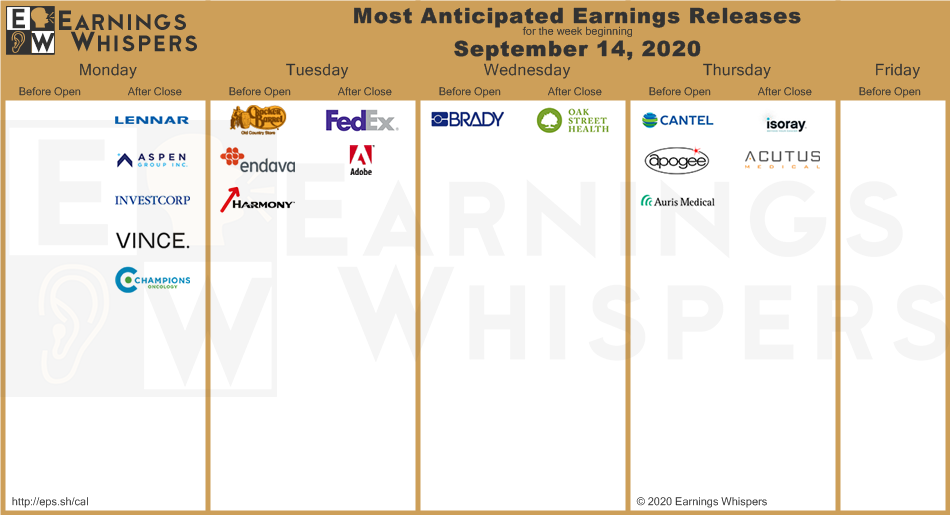
The week ahead — Economic data from Econoday.com:
Week of Sept 4, 2020 Weekly Recap & The Week Ahead

Tuesday, September 8th, 2020

When the Facts Change, I Change My Mind. What Do You Do, Sir?
John Maynard Keynes

1. Insurance Firms Gain Early Lead in Coronavirus Legal Fight With Businesses — U.S. property insurers have won a flurry of judicial rulings backing up their rejections of claims for businesses’ lost income during government-ordered shutdowns, dimming policyholders’ hopes of payments to help them rebound. Across the U.S., restaurants, hair salons, retailers and other businesses are seeking policy proceeds to deal with the huge economic cost of the shutdowns, in one of the biggest fights the insurance industry has ever waged with its policyholders. So far insurers have prevailed in state courts in California, Michigan and the District of Columbia, and in federal courts in Texas and California, according to a Covid-19 litigation-tracking effort at the University of Pennsylvania Carey Law School.
2. New York City Delays Reopening of Schools — the largest school district in the U.S. delayed the start of in-person teaching after Mayor Bill de Blasio and the teachers union reached an agreement and averted the threat of a strike over classroom safety concerns amid the coronavirus pandemic. The school district, with about 1.1 million students, has a hybrid model, in which some students will take online classes daily while others take remote classes for part of the week and attend school in person the other days. The district is the only major U.S. school system moving forward with a return to in-person learning in September.
3. U.S. Debt Is Set to Surpass the Size of the Economy — U.S. government debt will exceed the size of the economy, at $3.311 trillion, for the first time since World War II. Federal debt is projected to reach or exceed 100% of U.S. gross domestic product, according to the nonpartisan Congressional Budget Office, for the fiscal year, which ends Sept. 30. The last time U.S. debt was higher than economic output was in 1946, when it was 106% after financing military operations to help end World War II, The Wall Street Journal reported.
4. U.S. Stocks Routed Amid Decline in Tech Shares — the tech-heavy Nasdaq Composite dropped nearly 5% to 11458, its biggest one-day percentage decline since June 11, in a reversal of a rally that had taken it and the S&P 500 to new highs. The S&P 500 lost 3.5% to 3455, with all 11 sectors showing losses. The uptick in market volatility could be due to a large number of call options, which confer the right to buy shares, on technology stocks such as Apple and Tesla, according to Saxo Bank. Market makers have been forced to take the other side of such trades, buying the underlying stocks to hedge their positions.

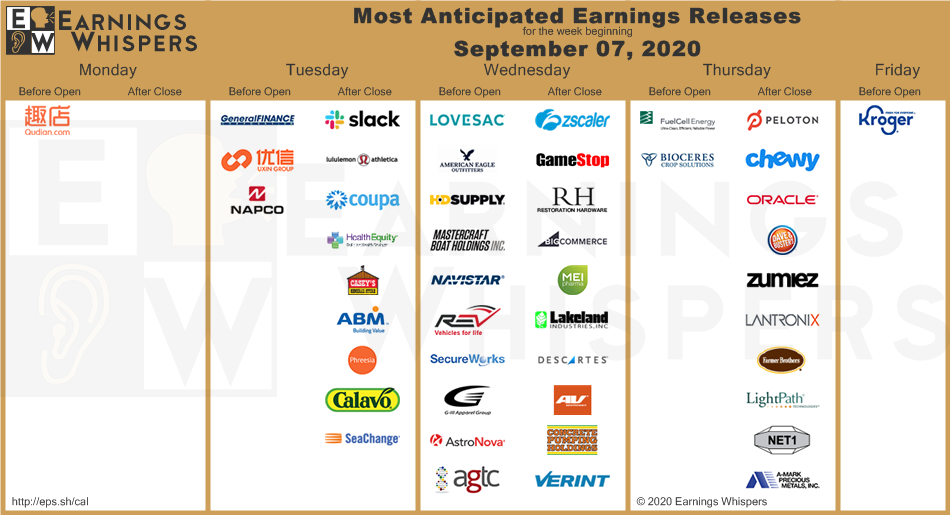
The week ahead — Economic data from Econoday.com:
Week of Aug 28, 2020 Weekly Recap & The Week Ahead

Tuesday, September 1st, 2020

“Do more of what works and less of what doesn’t.” – Steve Clark

1. Dow Jones Industrial Average (DJIA) Shuffles Members — Salesforce, Amgen and Honeywell to be added to DJIA while Exxon, Pfizer and Raytheon will be removed; The changes will take place Aug. 31 and were prompted by Apple Inc.’s AAPL, -1.86% decision to carry out a 4-for-1 stock split, reducing the index’s tech-sector weighting. “The announced changes help offset that reduction.
2. U.S. Sanctions Chinese Firms and Executives Active in Contested South China Sea — The U.S. unveiled a set of visa and export restrictions targeting Chinese state-owned companies and their executives involved in advancing Beijing’s territorial claims in the contested South China Sea, a new challenge to China involving the strategic waters. The U.S. added 24 Chinese companies active in the South China Sea—including five CCCC subsidiaries—to a Commerce Department list that restricts U.S. companies from supplying U.S.-origin technology to them without a license.
3. Fed Approves Shift on Inflation Goal, Ushering in Longer Era of Low Rates— The Federal Reserve announced a major policy shift, saying that it is willing to allow inflation to run hotter than normal in order to support the labor market and broader economy. The central bank formally agreed to a policy of “average inflation targeting.” That means it will allow inflation to run “moderately” above the Fed’s 2% goal “for some time” following periods when it has run below that objective.
4. Trump to Announce Deal With Abbott Laboratories for 150 Million Rapid Covid-19 Tests — President Trump is expected to announce a $750 million deal to buy 150 million rapid Covid-19 tests from Abbott Laboratories, a move that would substantially expand the nation’s capacity for rapid testing. The Food and Drug Administration on Wednesday granted emergency-use authorization to the company for a $5 rapid-response Covid-19 antigen test that is roughly the size of a credit card. The test could be administered in a doctor’s or school nurse’s office and uses technology similar to home pregnancy tests. It returns results in about 15 minutes. Abbott said Wednesday it plans to ship tens of millions of the tests in September and expects to increase production to 50 million tests in October. The October total would be roughly double the number of tests performed in the U.S. in July. Abbott said its data show the new antigen test has demonstrated sensitivity—the percent of positive cases a test accurately detects—of about 97%. Rapid antigen tests are generally thought to be less sensitive than lab-based PCR tests.

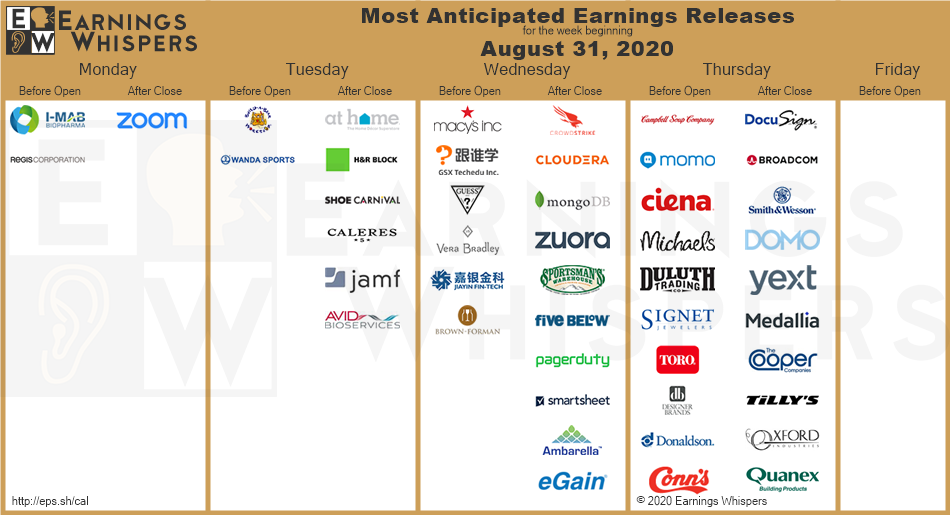
The week ahead — Economic data from Econoday.com:
Week of Aug 22, 2020 Weekly Recap & The Week Ahead

Monday, August 24th, 2020

‘They know that overstaying the festivities — that is, continuing to speculate in companies that have gigantic valuations relative to the cash they are likely to generate in the future — will eventually bring on pumpkins and mice. But they nevertheless hate to miss a single minute of what is one helluva party. Therefore, the giddy participants all plan to leave just seconds before midnight. There’s a problem, though: They are dancing in a room in which the clocks have no hands.’ — Warren Buffett

1. U.S. Further Tightens Huawei Restrictions — the Commerce Department said that it was restricting Chinese tech-giant Huawei’s access to foreign chips made using U.S. technology on the grounds that it could be used to spy on Americans. The new rule requires non-U.S. firms to get a special license to sell any chips, including off-the-shelf chips, made using U.S. technology to Huawei. A previous rule, imposed by the Trump administration on Huawei in May, was aimed largely at limiting the ability of Huawei’s HiSilicon unit from importing chips made by Taiwan Semiconductor Manufacturing using American chip-making technology. Huawei has already said it would stop making its top-end cellphone chip in mid-September because it can’t get the components. The new rule, which takes effect on Sept. 15, will further curtail Huawei’s ability to source parts for its products.
2. Democrats Nominate Joe Biden in Virtual Roll Call — Democrats formally made Joe Biden their presidential nominee, a role he has sought for more than three decades, capping a come-from-behind victory in the primaries he secured with a broad coalition of his party’s voters. The program included remarks from former Presidents Bill Clinton and Jimmy Carter, and former Secretary of State John Kerry, who was also the Democratic presidential nominee in 2004. “Our party is united in offering you a very different choice: a go-to-work president,” Clinton said.
3. Regeneron and Roche Team Up on Antibody Treatment — Regeneron Pharmaceuticals is partnering with rival drug maker Roche Holding to develop and manufacture Regeneron’s experimental Covid-19 antibody treatment. The treatment, which has not yet been approved by the Food and Drug Administration, is based on a cocktail of two antibodies that neutralize the virus in a manner similar to the way HIV and hepatitis C drug cocktails work. The cocktail is being tested as a treatment for people already infected with the virus and as a prophylactic for those likely to be exposed to the virus, such as front-line health care workers. It is currently in final Phase II/III human trials. In related news, the FDA has delayed an emergency use authorization for a Covid-19 treatment that uses blood plasma of recovered Covid-19 patients after top health officials concluded that clinical trials failed to show it worked.
4. FDA Authorizes Convalescent Plasma for Covid-19 Use — the FDA called an emergency-use authorization, permits use of the treatment on hospitalized Covid-19 patients. For Covid-19 patients and the doctors who treat them, the designation opens up the possibility for faster and easier access to a promising treatment. But the FDA said more clinical studies are necessary for definitive proof of the therapy’s effectiveness. Doctors have been looking for validated coronavirus treatments. Until now, only one other drug, remdesivir from Gilead Sciences Inc., has the FDA’s emergency-use OK. Hospitalized patients who received the plasma within three days of diagnosis, are under the age of 80 and not on mechanical ventilation, benefited the most, with a 35% improvement in survival 30 days after receiving the transfusion compared with patients who got plasma with low antibody levels, according to Dr. Marks.

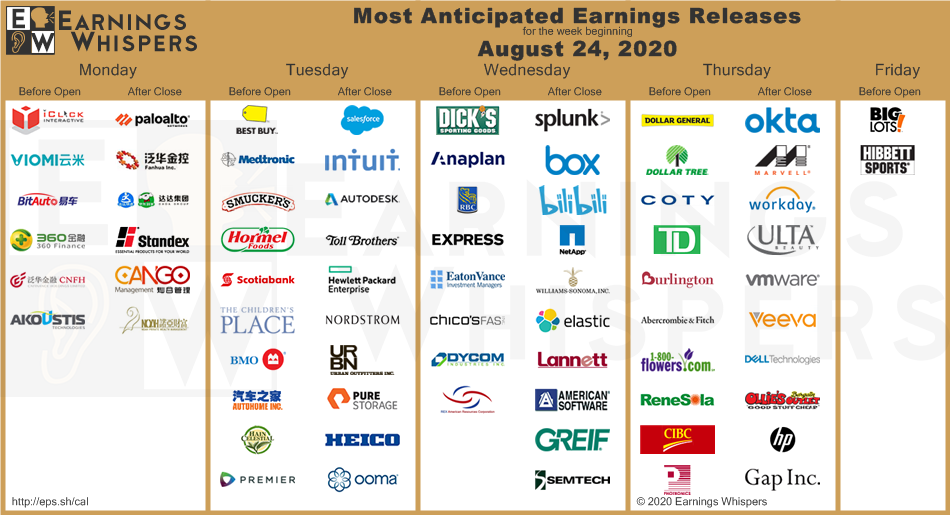
The week ahead — Economic data from Econoday.com:
href=”http://s317550275.onlinehome.us/Blog/admin/2020/08/24/week-of-aug-22-2020-weekly-recap-the-week-ahead/earnings_weekaug282020-2/” rel=”attachment wp-att-11766″>

Week of Aug 15, 2020 Weekly Recap & The Week Ahead

Monday, August 17th, 2020

“Maybe they’ll get more overvalued. I think that’s the argument for being long today is that …continued overvaluation and [they can] get even more so. But they’re overvalued and this is the setup up for left tail events in stock markets,” — trader Mark Spitznagel

1. Trump Authorizes Extending Special Unemployment Benefit at $400 a Week — President Trump directed the federal government Saturday to provide $300 a week in additional payments to the unemployed and called on states to fund an extra $100 in weekly benefits. The measure was one of four the president signed to extend coronavirus aid after negotiators for the White House and Democrats in Congress failed to reach an accord. The order signed by Mr. Trump authorized states to pay $400 a week in added benefits, but only funded 75% of that. It was uncertain how states would respond. Many have seen revenues fall amid fallout from the pandemic and have asked Congress for help to avoid cuts to services and more layoffs of first responders.
2. Joe Biden Picks Kamala Harris as Running Mate — Joe Biden named Sen. Kamala Harris of California as his running mate, picking his former Democratic primary opponent to be the first Black woman nominated for vice president by a major party. Harris, 55, is the first Black woman and the first person of Indian descent ever nominated for national office by a major political party.
3. Weekly Jobless Claims Drop Below One Million for First Time Since March — New applications for unemployment benefits dropped to seasonally adjusted 963,000 in the week ended Aug. 8, the Labor Department reported. Claims are down significantly from a peak of near seven million in March, but remain at historically high levels and higher than the pre-pandemic record of 695,000. President Trump signed an executive action Saturday that authorized states to extend a federally funded $300 in benefits and provide an extra $100 in state-funded benefits. States likely won’t start implementing the supplemental benefits for weeks, as they must apply for the federal funds and set up new programs.
4. Retail Sales Point to a Rocky Economic Recovery — Total retail sales rose a seasonally adjusted 1.2% last month from June, the Department of Commerce said Friday. That follows month-over-month gains of 8.4% and 18% in the preceding months, after retail sales plummeted 15% in April. Excluding more volatile categories like gasoline, motor vehicles and building materials, retail sales rose 1.4% in July, better than economists’ 1.1% estimate but slower than the 6% and 10% rates in June and May. Gains were strongest at electronics and appliance stores (up 23% from a month earlier), while sales at gas stations and clothing stores rose 6% and restaurant and bar sales increased 5%.

The week ahead — Economic data from Econoday.com:
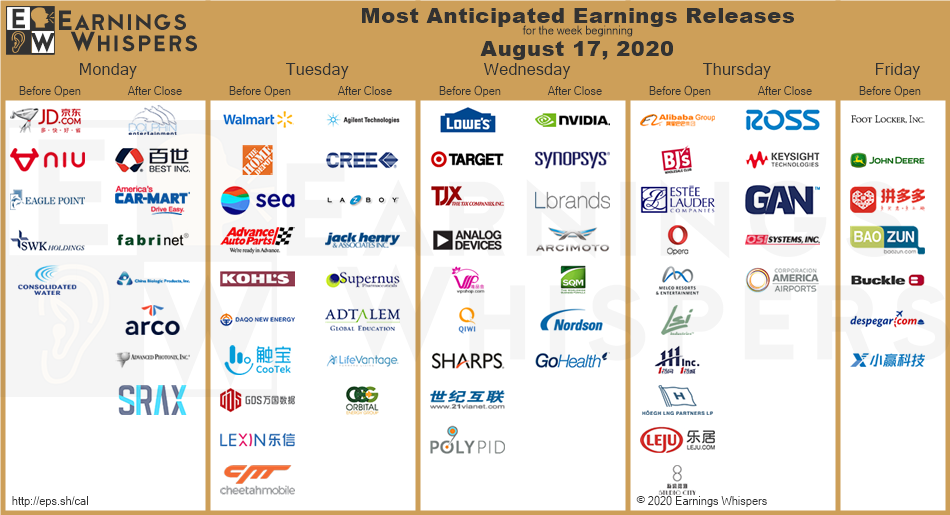
Week of Aug 9, 2020 Weekly Recap & The Week Ahead

Tuesday, August 11th, 2020

There will not be any re-cap for the week of August 7 2020 due to power outages.
Have a good week.

The week ahead — Economic data from Econoday.com:
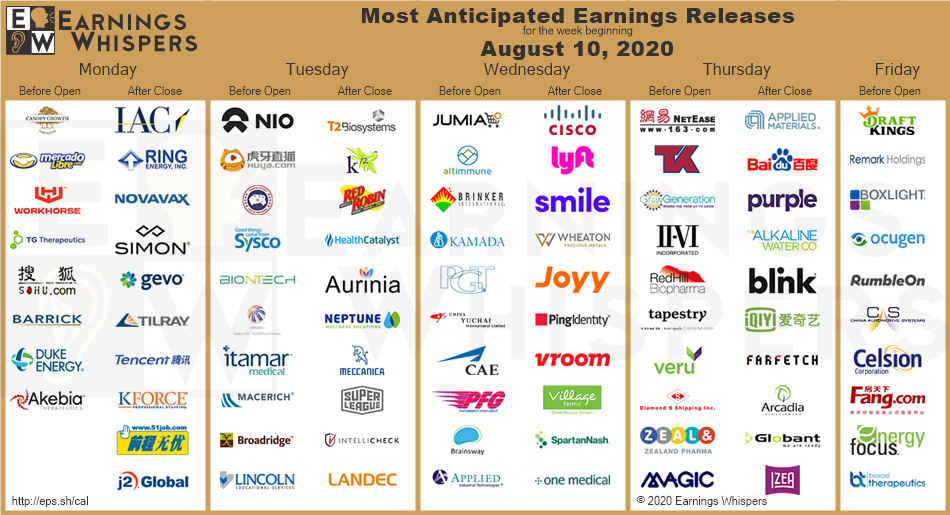
Week of July 31, 2020 Weekly Recap & The Week Ahead

Monday, August 3rd, 2020

“The process of intelligently building a portfolio consists of buying the best investments, making room for them by selling lesser ones, and staying clear of the worst.” – Howard Marks

1. Violence Erupts Around Protests Across U.S. — large demonstrations turned violent around the country over the weekend as tens of thousands of Americans continued a monthslong wave of civil unrest protesting racism and police tactics. Police officials in Portland and Seattle declared some demonstrations in their cities “riots” and used pepper spray and other crowd-control tools to disperse gatherings. President Trump sent federal agents to Portland earlier this month and is now sending federal resources into other cities to quell protests and suppress surges in crime.
2. Trump Administration to Halt New DACA Applicants — the Trump administration announced rollbacks of an Obama-era program that benefited immigrants who have lived in the U.S. illegally since childhood, including a prohibition on new applicants. The administration had been hinting for weeks that it would again move to end DACA, but it chose not cancel the program entirely right now for fear that a rush to do so would run afoul of the Supreme Court’s instruction to take a more considered approach.
3. AMC, Universal Agree to Trim Theatrical Window Before Movies Go Online — under the deal, the “theatrical window” will shorten to 17 days, from the current 75, at least when it comes to movies made by Comcast Corp. ’s Universal that play at AMC theaters, the world’s biggest movie-theater chain. That means that instead of waiting 2½ months to watch a new movie at home, viewers will be able to see at least some titles just 2½ weeks after they premiere in theaters. Movie theaters have long considered it essential for their businesses to be able to play movies exclusively before consumers can watch them other ways.
4. 2Q GDP Contracted at Record Rate Last Quarter — the Commerce Department reported U.S. gross domestic product—the value of all goods and services produced across the economy—fell at a 32.9% annual rate in the second quarter, or a 9.5% drop compared with the same quarter a year ago. Both figures were the steepest in records dating to 1947. A surge in virus infections since mid-June appears to be slowing the recovery in some states, according to some private-sector real-time data.
5. Sanofi, GlaxoSmithKline Ink Coronavirus Vaccine Deal With U.S. — the U.S. government will pay up to $2.1 billion to Sanofi and GlaxoSmithKline to fund the development of a coronavirus vaccine and guarantee supply of 100 million doses, if proven safe and effective in clinical trials. The contract is the latest in a series of deals—potentially worth more than $8 billion—struck by the U.S. government aimed at accelerating development of Covid-19 vaccines and securing large supplies before potential product approvals.
The U.S. has reached deals worth over $1 billion each with vaccine makers including Pfizer Inc. and partner BioNTech SE, AstraZeneca PLC and its partner the University of Oxford, and Novavax Inc., a biotech company in Gaithersburg, Md. Each of the deals guarantees the U.S. 100 million doses or more, if the vaccines are approved by regulators.

The week ahead — Economic data from Econoday.com:
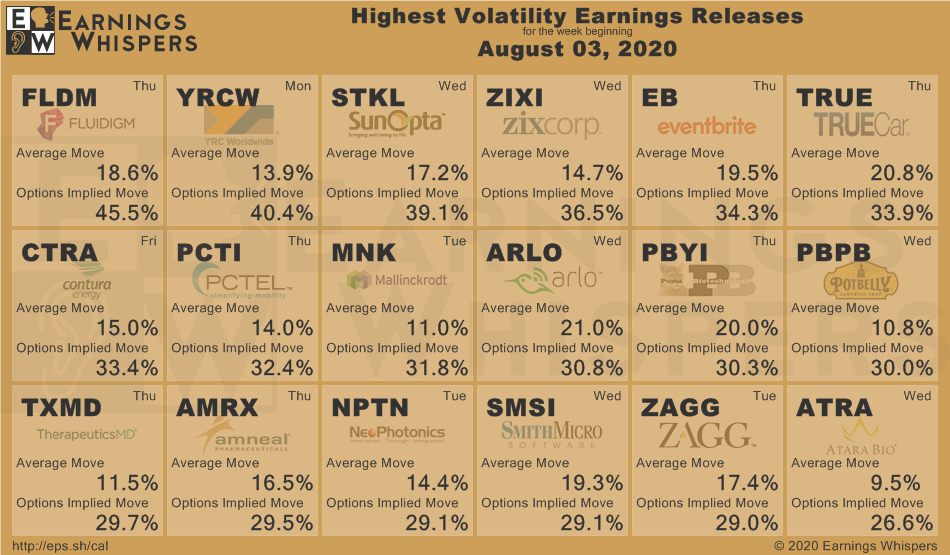
Week of July 25, 2020 Weekly Recap & The Week Ahead

Monday, July 27th, 2020

‘This market is setting up to be one of the great short opportunities of all time. Trouble’s coming, I don’t know when, but it’s coming.’ — Jim Chanos

1. U.S. Orders China to Close Houston Consulate — the U.S. ordered China to shut its consulate in Houston, with officials accusing it and other Chinese diplomatic missions of economic espionage and visa fraud. FBI agents have interviewed Chinese researchers suspected of being undeclared members of the People’s Liberation Army in more than 25 cities, according to some U.S. officials. In some instances, staff at Chinese consulates helped instruct some researchers on security, reminding them to delete information from their electronic devices. The Chinese retaliates with Beijing set a 72-hour limit for the Chengdu Consulate to shut down, according to people briefed on the matter, the same amount of time Washington gave Chinese diplomats to vacate the Houston Consulate. U.S. diplomats at the Chengdu Consulate were given 30 days to leave China, the people said.
2. Weekly Unemployment Rises for First Time in Nearly Four Months — initial unemployment claims rose by a seasonally adjusted 109,000 to 1.4 million for the week ended July 18, the Labor Department reported, halting what had been a steady descent from a peak of 6.9 million in late March, when the pandemic and business closures shut down parts of the U.S. economy. Last week’s increase in applications came after several states imposed new restrictions on businesses such as bars and restaurants when coronavirus cases rose.
3. Pfizer, BioNTech Get $1.95 Billion Covid-19 Vaccine Order From U.S. Government — the U.S. has agreed to pay Pfizer Inc. PFE -2.47% and BioNTech SE nearly $2 billion to secure 100 million doses of their experimental Covid-19 vaccine to provide to Americans free of charge. No Covid-19 vaccine in development has proven to work safely yet, although dozens are being studied. The U.S. and other governments are spending billions of dollars to secure potential Covid-19 vaccines and treatments should they prove safe and effective.
4. Senate Republicans Prepare to Unveil Their Coronavirus Relief Package — Senate Republicans prepared to roll out their opening offer for a fifth coronavirus relief package after ironing out differences with the White House. The plan will include $16 billion in new funding for testing, a compromise between Senate Republicans who had sought more money and the White House, which had opposed any new funding. More than $100 billion will go toward schools, with some of that money only available to K-12 schools that plan to physically reopen. It wasn’t immediately known if a payroll-tax cut would be included in the GOP plan. Lawmakers are racing to reach an agreement before a $600 weekly supplement to the unemployment benefits expires on July 31. Republicans were looking at several options, including continuing the federal supplement at a lower flat rate until states can scale the benefit based on previous income.

The week ahead — Economic data from Econoday.com:
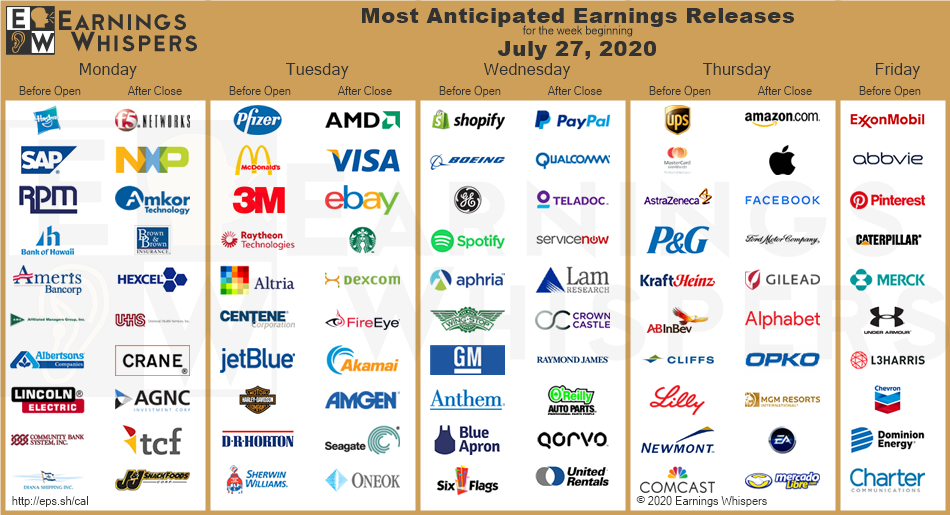
Week of July 18, 2020 Weekly Recap & The Week Ahead

Tuesday, July 21st, 2020

There will not be any re-cap for the week of July 18 2020. We are away for some needed R&R.
Have a good week.

The week ahead — Economic data from Econoday.com:
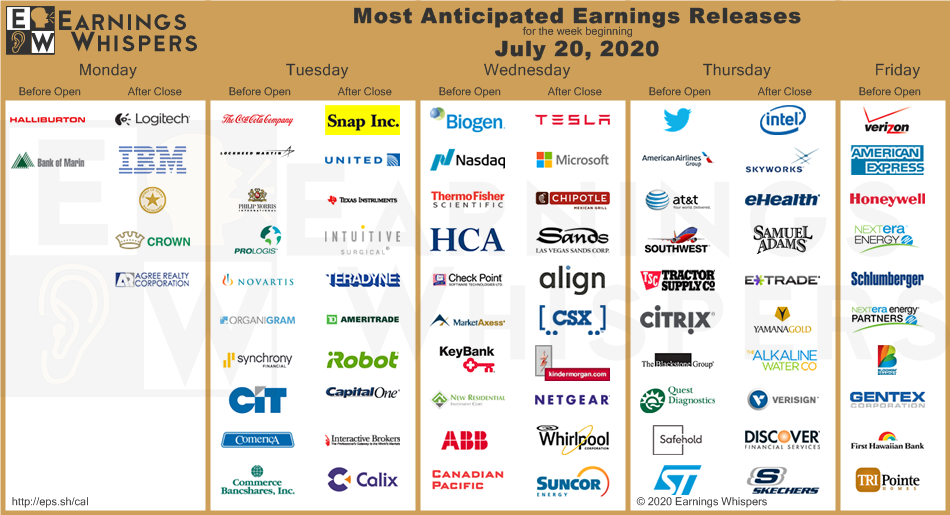
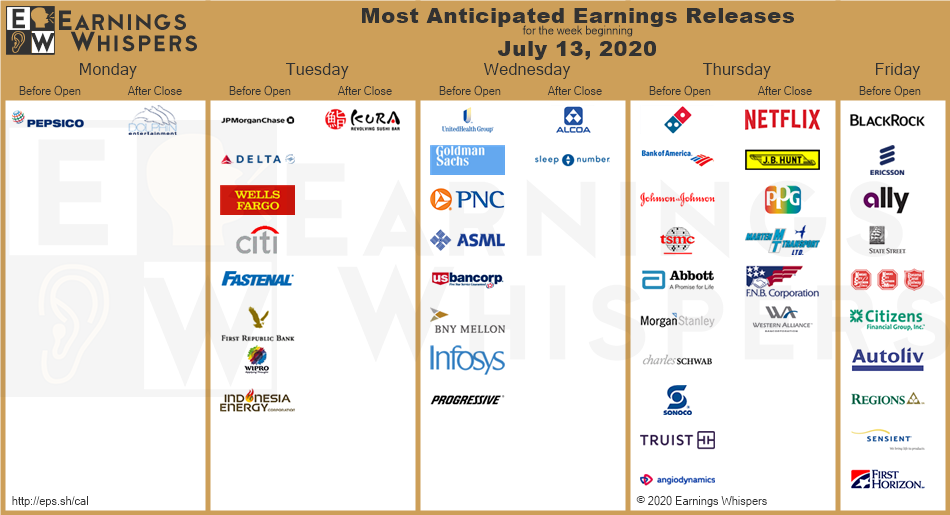
Week of July 11, 2020 Weekly Recap & The Week Ahead

Tuesday, July 14th, 2020

“There are three ingredients for success—aggressiveness, timing and skill—and if you have enough aggressiveness at the right time, you don’t need that much skill.”
― Howard Marks

1. Novavax, Regeneron are awarded $2 Billion for Covid-19 Vaccine, Drug Supplies — Novavax would receive $1.6 billion from the federal government’ to fund clinical studies of its experimental coronavirus vaccine and establish large-scale manufacturing of doses. With the funding, Novavax said it would deliver 100 million doses of its vaccine, possibly by the end of this year. Regeneron received a $450 million federal contract to manufacture thousands of doses of its experimental Covid-19 treatment that the government will distribute at no cost to the public if the drug is authorized for use by regulators.
2. Trump Moves to Pull U.S. Out of World Health Organization — the U.S. has formally notified the World Health Organization it will withdraw from the United Nations agency over President Trump’s criticism of its ties to China. The exit won’t take effect until next July, leaving it contingent on Mr. Trump’s re-election. His rival for the White House, presumptive Democratic presidential nominee Joe Biden, said Tuesday the U.S. would remain a member if he wins.
3. Recession Forces Spending Cuts on States, Cities Hit by Coronavirus — governments have cut 1.5 million jobs since March, mostly in education, and more reductions are likely barring a quick economic recovery. In addition, State and local governments from Georgia to California are cutting money for schools, universities and other services as the coronavirus-induced recession wreaks havoc on their finances. Almost all states and local governments require balanced budgets. For now, they have largely avoided raising taxes to plug budget holes, opting instead to cut spending or dip into reserves.
4. Supreme Court Paves the Way for N.Y. Prosecutor to View Trump Taxes — The Supreme Court paved the way for a New York prosecutor to enforce a subpoena for President Trump’s financial and tax records. The decision send the cases back to lower courts, where Mr. Trump can raise additional objections to the subpoenas. The rulings put off, likely until after the November election, any ability to see Mr. Trump’s financial records.

The week ahead — Economic data from Econoday.com:
Search
Calendar
February 2026
M T W T F S S
« Jan    
 1
2345678
9101112131415
16171819202122
232425262728  
Archives
Categories
The information provided by The EGS Blog is based on sources believed to be reliable, but it is not guaranteed to be accurate. There is no guarantee that the recommendations of The EGS Blog will be profitable or will not be subject to losses. The information provided by The EGS Blog is not a recommendation or a solicitation that any particular investor should purchase or sell any particular security in any amount, or at all. The investments discussed or recommended herein may be unsuitable for investors depending on their specific investment objectives and financial position. At any time EGS LLC and its principals may maintain positions that are contrary to positions announced within the subscription service. In no event will The EGS Blog be liable to you or anyone else for any incidental, consequential, special, or indirect damage (including but not limited to lost profits or trading losses). PAST PERFORMANCE IS NO GUARANTEE OF FUTURE RESULTS

© Copyright 2026 Market Outlook All Rights Reserved
Design by EGS Sponsored by Equity Guidance LLC