Archive for the ‘Weekly Summary’ Category

Week of Nov 20, 2020 Weekly Recap & The Week Ahead

Monday, November 23rd, 2020

“How? Try to travel into the future and look back. In 2023, do you think you’re more likely to say, “Back in 2018, I wish I’d been more aggressive” or “Back in 2018, I wish I’d been more defensive”? And is there anything today about which you’d be likely to say, “In 2018, I missed the chance of a lifetime to buy xyz”? What you think you might say a few years down the road can help you figure out what you should do today.”
― Howard Marks

1. Amazon Expands Push Into Health Care With Online Pharmacy — the e-commerce giant on Tuesday unveiled Amazon Pharmacy, a section of its retail website and mobile application that lets people order medication. Shoppers can pay using their health insurance. Prime members who don’t use their insurance are eligible for discounts on generic and brand-name drugs on Amazon’s site or at about 50,000 participating pharmacies. Amazon’s new offering comes more than two years after its $753 million acquisition of PillPack, an online pharmacy known for organizing prescriptions into packets. This expansion puts the Seattle-based e-commerce company into more direct competition with pharmacy giants CVS Health Corp. and Walgreens Boots Alliance Inc., the two largest chains in the U.S.
2. Tesla Was Finally Added to the S&P 500 — S&P Dow Jones said the 17-year-old company would be added to the gauge in December. The committee is seeking feedback from investors on whether to add it in two separate pieces, an unprecedented step. At almost $390 billion in value and growing, Elon Musk’s company would be the biggest ever added to the benchmark. Given its heft, Tesla would likely be among the top 10 largest stocks in the S&P 500, falling somewhere between Johnson & Johnson and Procter & Gamble Co., with a weighting of more than 1%. That would equal the combined value of the 60 smallest stocks in the benchmark.
3. The Boeing 737 MAX Jet Is Back — the FAA rescinded its temporary grounding of the plane, an order that had been in place for 616 days, or almost 20 months, beginning on March 13, 2019. The FAA officially directed at aircraft safety inspectors, investigators, and flight standards personnel responsible for aircraft oversight. They need to make sure all the MAX jets have updated sensors and software and that pilots have received the appropriate training.
4. US Covid Death Toll Passes 250,000 — The US, which has now registered 250,029 fatalities, has by far the highest national death toll, ahead of Brazil with 166,699 deaths, India with 130,993 deaths and Mexico with 99,026. Two trial vaccines have recently performed well in tests, offering hope for the US and world. The novel coronavirus has killed more than 1,343,000 people since the outbreak emerged in China last December.

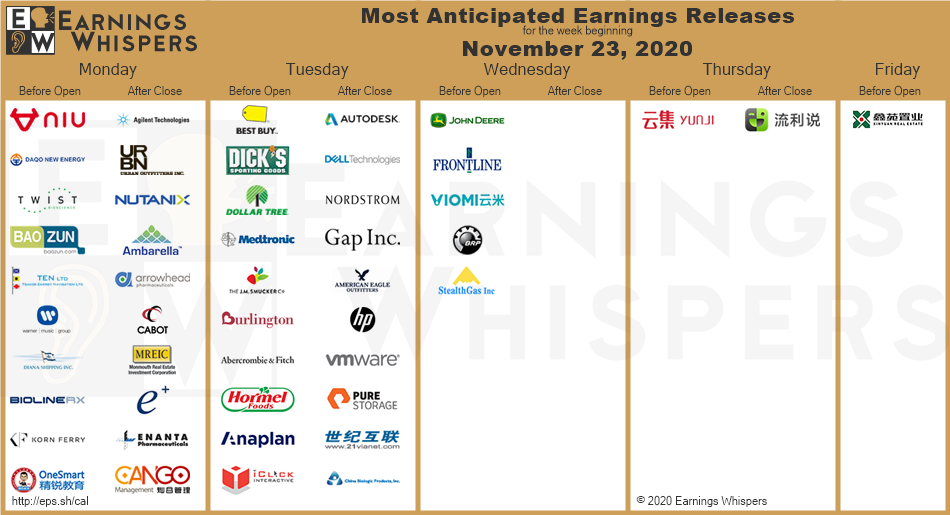
The week ahead — Economic data from Econoday.com:
Week of Nov 13, 2020 Weekly Recap & The Week Ahead

Monday, November 16th, 2020

“the three stages of a bull market”: the first stage, when only a few unusually perceptive people believe things will get better, the second stage, when most investors realize that improvement is actually taking place, and the third stage, when everyone concludes things will get better forever.” ― Howard Marks

1. Pfizer’s Announces Covid-19 Vaccine — Pfizer and partner BioNTech announced early and not yet complete data from their Phase three Covid-19 vaccine trial. It is “more than 90% effective in preventing Covid-19” in trial participants, according to the release. The companies are gathering additional safety and efficacy data and preparing to submit them to global regulatory authorities for approval. Regulatory filings are expected later this month. The Phase three trial enrolled more than 43,000 participants. Phase three trials are typically the final phase before the FDA considers a drug or vaccine for approval. Pfizer plans to produce 50 million doses in 2020 and 1.3 billion doses in 2021.
2. Supreme Court Hears Arguments Against Affordable Care Act –tThe Supreme Court heard arguments in a case some fear could end the Affordable Care Act. At least two justices seemed open to keeping the majority of the bill. The case centers on the Affordable Care Act’s individual mandate. Originally deemed constitutional because the penalty was ruled a tax by a majority of the Supreme Court, Republican attorneys general from 18 states argue the 2017 removal of the penalty makes it no longer a tax.
If the Supreme Court agrees, the bigger question would be whether or not the individual mandate could be severable from the rest of the bill. Republicans argue it can’t, while Democrats disagree and warn millions of Americans would lose health care and pre-existing condition protections amid a pandemic.
3. Covid Hot Spots Show Signs Europe’s New Wave May Be Cresting — With France, Spain, the U.K. and Italy — alongside Russia, all recording more than 1 million cases, the headlines remain grim. As the U.S. surpasses 10 million infections, Europe has been another epicenter of the pandemic’s autumn surge. Over the past week, however, the number of new cases has plateaued or begun to ease in the U.K., Germany and France. Harder-hit small countries such as Belgium, the Netherlands, and the Czech Republic have posted big declines in daily infection rates. Belgium’s seven-day average of about 5,200 new cases, for example, was down from peak levels of more than 20,000 a day less than two weeks ago.
4. Cases Surge While Stimulus Talks Stall and Targeted Lockdowns Continue — as the Midwest deals with a surge of Covid-19 infections cases, more states and cities are bringing back restrictions. Chicago Mayor Lori Lightfoot issued a 30-day stay-at-home advisory for the city, beginning on Monday. The Chicago mayor pointed to an “alarming and ongoing surge” in cases. Illinois saw 12,000 new cases Thursday, according to the Covid Tracking Project, the most of any state. Ohio’s Republican Gov. Mike DeWine on brought back a mask mandate for going out in public. This time, businesses must also have signs at the entrance stating masks are required. They must also make sure employees and customers wear masks. The state had 7,000 cases Thursday. In addition to Illinois and Ohio, California, Texas, Wisconsin, Minnesota, Michigan, Indiana, Pennsylvania, and Florida all saw more than 5,000 new cases late last week. Bloomberg reported that the White House is yielding stimulus negotiations to Senate Majority Leader Mitch McConnell. Though talks between House Speaker Nancy Pelosi and Treasury Secretary Steven Mnuchin sparked some optimism for investors in October, hopes for a deal before next year have stalled.
5. Moderna Vaccine Found Highly Effective at Preventing Covid — Moderna Inc. said its Covid-19 vaccine was 94.5% effective in a preliminary analysis of a large late-stage clinical trial. The highly positive readout comes just a week after a similar shot developed by Pfizer Inc. and BioNTech SE was found to be more than 90% effective in an interim analysis. Both shots rely on a technology called messenger RNA that has never been used to build an approved vaccine. Moderna said that new stability data showed its vaccine is stable at refrigerator temperatures for 30 days, much longer than a previously estimated seven days. For longer-term storage, it can be kept in freezers, though it doesn’t need the special facilities required for the Pfizer vaccine. Both the Moderna vaccine and Pfizer’s are based on mRNA technology designed to transform the body’s own cells into vaccine making factories. Once injected, the vaccines instruct cells to make copies of the coronavirus’s spike protein, stimulating the creation of protective antibodies.

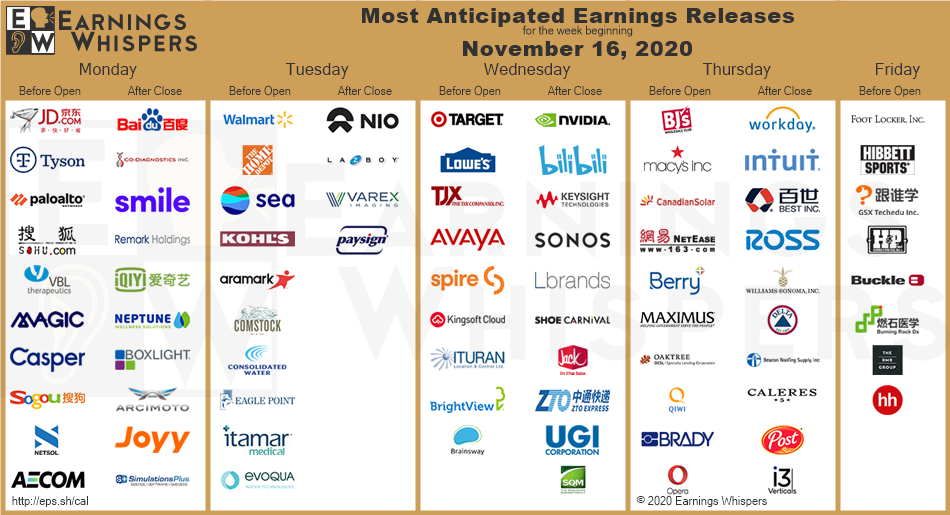
The week ahead — Economic data from Econoday.com:
Week of Nov 6, 2020 Weekly Recap & The Week Ahead

Tuesday, November 10th, 2020

“Investing is a popularity contest, and the most dangerous thing is to buy something at the peak of its popularity. At that point, all favorable facts and opinions are already factored into its price, and no new buyers are left to emerge.”
― Howard Marks

1. Biden Wins U.S. Presidential Election — America has chosen Democrat Joe Biden as its 46th president with 290 electoral votes versus Trump at 214. However, Republicans escalated their efforts to overturn Joe Biden’s victory in the 2020 election, refusing to acknowledge Donald Trump’s defeat, as the president-elect moved more forcefully to make the transition to the White House.The most significant move came from Attorney General William Barr, who on Monday authorized Justice Department officials to open inquiries into potential irregularities in the presidential election, though he acknowledged there’s no conclusive evidence.
2. The Travel Industry Is Still in Serious Trouble — Norwegian Cruise Line Holdings extended its suspension of cruise voyages on Monday through Dec. 31 despite the Centers for Disease Control and Prevention saying on Friday that its no-sail order was being lifted as of Oct. 31. Meanwhile, Royal Caribbean Group said Friday that it too has “a lot of work to do between now and then,” referring to when its ships will return to service. It did not provide a date for when it might begin voyages again. The CDC move came with stringent requirements. Before sailing again, cruise lines would have to ensure testing for crew members, simulate voyages to test response and mitigation practices, and receive certification by the CDC that passengers are allowed to return. Airlines stocks have also been under pressure as Covid-19 cases continue to rise and prospects fade for another stimulus bill soon. New aid is unlikely to be approved at least until the next Congress begins in late January.
3. McConnell Says Senate Will Start Working on a New Stimulus Bill — Majority Leader Mitch McConnell said that the upper chamber will start work on another round of stimulus when it returns. McConnell added that “it’s a possibility we will do more for state and local governments,” a key stumbling block in pre-election talks.
Tossing out the possibility of additional state and local aid could be McConnell’s way of showing he’s open to a deal—if House Speaker Nancy Pelosi goes along with one of his asks, such as a liability shield for employers. Such liability shield language has been anathema to Democrats, but Pelosi might be willing to concede it given that the GOP currently appears on track to hold a slightly slimmed-down Senate majority.
4. Qualcomm Jumps on Outlook for Booming 5G Chip Demand — the company said it was going to sell millions of chips for 5G mobile devices as people upgrade their phones. The chip maker, known for its wireless communication chips for smartphones, reported fiscal fourth-quarter net income of $2.96 billion, which amounts to $2.58 a share, compared with a net profit of $506 million. CEO Mollenkopf was keen to highlight the progress he has made diversifying Qualcomm beyond the phone market. Revenue from chips sold to makers of vehicles and internet-connected gadgets totaled $3.67 billion in fiscal 2020, Qualcomm reported.
Last month, a U.S. appeals court said it won’t reconsider an earlier decision that threw out antitrust claims against Qualcomm in a case brought by U.S. Federal Trade Commission. That decision ends years of major legal fights and regulatory actions against the company.Apple Inc. and China’s Huawei Technologies Co. became the last major handset suppliers to sign new licensing agreements with Qualcomm. Apple has also returned to using Qualcomm silicon in the iPhone.
5. Control of Senate Hinges on Georgia Runoffs — two January runoff races in Georgia could determine which party controls the Senate if Biden wins the White House. Democrats have picked up just one Senate seat overall. With the chamber split 53 to 47 in favor of the GOP, they need two more seats to split the Senate 50-50. If Biden wins the White House, then-Vice President Kamala Harris would break the tie. As votes continue to be counted in Georgia, the state’s two Senate contests are headed to runoffs. Candidates there must get more than 50% to be declared the winner. If Biden wins, a GOP-controlled Senate would almost certainly take progressive policies like a Green New Deal, increased taxes on high-earners and corporations, or a public health insurance option off the table.

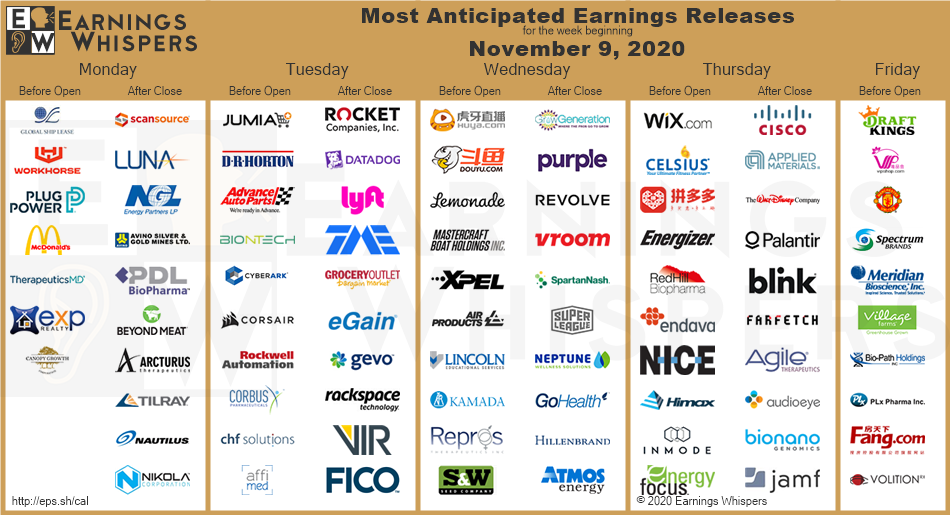
The week ahead — Economic data from Econoday.com:
Week of Oct 31, 2020 Weekly Recap & The Week Ahead

Tuesday, November 3rd, 2020

“Every once in a while, an up-or-down-leg goes on for a long time and/or to a great extreme and people start to say “this time it’s different.” They cite the changes in geopolitics, institutions, technology or behaviour that have rendered the “old rules” obsolete. They make investment decisions that extrapolate the recent trend. And then it turns out that the old rules still apply and the cycle resumes. In the end, trees don’t grow to the sky, and few things go to zero.”
― Howard Marks

1. Barrett Confirmed to Supreme Court — Amy Coney Barrett’s confirmation by the Senate was a touchstone accomplishment for President Donald Trump and congressional Republicans that solidifies a 6-3 conservative majority on the Supreme Court just eight days before the U.S. election. The Senate confirmed Barrett on a partisan 52-48 vote, and Justice Clarence Thomas administered the first of two required oaths to Barrett on the South Lawn of the White House a short time later with Trump looking on. Chief Justice John Roberts will administer the second oath in a private ceremony at the Supreme Court. Barrett may be asked to weigh in on cases that would determine the outcome of a close election, and is expected to vote on whether the Affordable Care Act is constitutional soon after she joins the court.
2. U.S. Infections Continue to Climb — Covid-19 cases in the U.S. have hit new highs, with the seven-day average of additional daily infections hitting 68,767 , according to data compiled by Johns Hopkins University. This surge has hit Midwest and Rocky Mountain states the worst and comes at a particularly worrying time for public health officials as temperatures fall and people are more likely to congregate indoors, where Covid-19 is spread more easily. During the summer surge in the U.S., which hit Sun Belt states the hardest, the seven-day average peaked at just under 67,000 in late July. One potential vector for infections has, so far, not materialized. Outbreaks related to primary schools appear to be extremely limited, and the partial reopening of the biggest school district in the country in New York City has resulted in just 28 positive tests for Covid-19 out of 16,298 randomized tests.
3. Germany, France Impose Strict Month-Long Curbs to Rein in Virus — Germany and France will clamp down on movement for at least a month, coming close to the stringent lockdowns in the spring as Europe seeks to regain control of the rapid spread of the coronavirus. The European Union’s two biggest economies will shutter bars, restaurants and non-essential services, while allowing schools and most businesses to operate. The approach by French President Emmanuel Macron and German Chancellor Angela Merkel seeks to strike a balance between protecting public health and avoiding another debilitating blow to the economy.
4. Covid-19 Vaccine Won’t Be Available Until January — Anthony Fauci, the nation’s top infectious-disease doctor, said a vaccine to help control the coronavirus outbreak isn’t likely to be available in the U.S. until January. The trials are designed to run until a predetermined number of people who are enrolled get sick. The studies currently underway are unlikely to hit those benchmarks until sometime in December. Once the data are available, the companies must analyze the findings, file with the U.S. Food and Drug Administration for emergency use and participate in an advisory committee hearing. There are five companies in the final stages of study for a coronavirus vaccine, with Pfizer Inc. and Moderna Inc. having fully enrolled their trials, Fauci said. At least one and maybe two of the companies will have enough safety data and perhaps even sufficient prolonged efficacy findings to apply for emergency use of their vaccines by December.

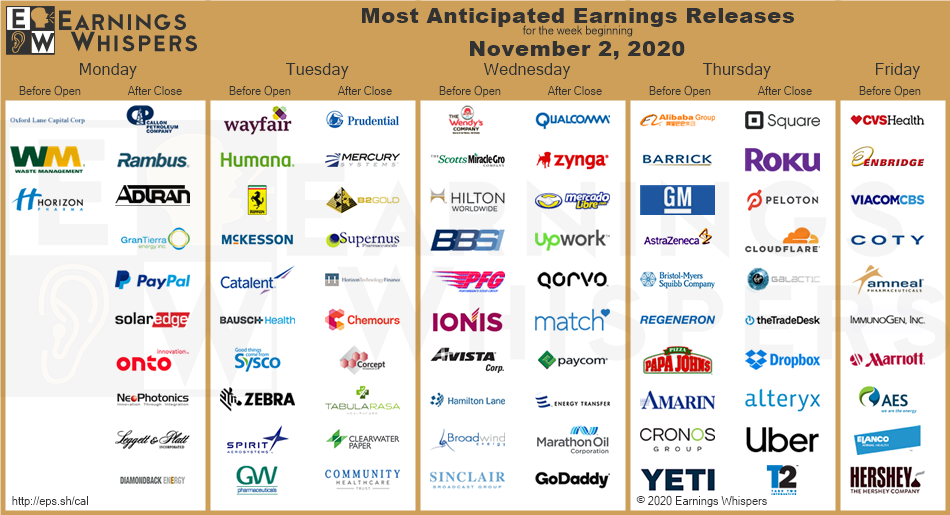
The week ahead — Economic data from Econoday.com:
Week of Oct 23, 2020 Weekly Recap & The Week Ahead

Monday, October 26th, 2020

The road to long-term investment success runs through risk control more than through aggressiveness. — Howard Marks

1. Apple Seeing Strong iPhone 12 Pro Orders in All Markets — prominent analyst reported that wait times are longer for the iPhone 12 Pro than the flagship iPhone 12 in all markets, “fitting the pattern of higher-end users more likely to buy early in the launch cycle,” Cabral says. IPhone 12 Pro demand appears highest in Asia, he notes, where wait times exceed three weeks on most models in both Japan and Hong Kong, with waits of two to three weeks in China, one to three weeks in Europe, and less than two weeks in the U.S.
2. Intel’s (INTC) Sells Nand Memory-Chip Unit to South Korea’s SK Hynix — SK Hynix will pay $9 billion for Intel’s Nand memory and storage business. The purchase includes Intel’s Nand solid-state drive business, Nand component and wafer business, and memory-chip manufacturing facility in Dalian, China. Intel will retain its Optane business and invest proceeds from the transaction to grow that business. The Optane division develops next-generation, nonvolatile memory chips with data speeds faster than Nand.The combination of SK Hynix and the Intel Nand unit will create the second largest Nand memory-chip producer behind industry leader Samsung. After the transaction, SK Hynix will have nearly 20% market share in Nand chips, vs. 35% for Samsung.
3. Hospitals Across the U.S. Are Crammed With Covid-19 Patients — U.S. hospitalizations for Covid-19 hit the highest point since Aug. 22, with New York doubling its count from early September and at least 10 other states reporting records. The U.S. on Tuesday had 39,230 people in hospitals, according to the Covid Tracking Project. Of those, 8,178 were in intensive-care units; it’s been two months since the U.S. had more under such care. The number on ventilators, 1,889, reached its highest since Sept. 10. Across the country, 37 states are reporting increased hospitalizations, including 21 states that have recently reported new records or are approaching previous highs, according to Johns Hopkins University data. While the trend is national, the hardest-hit region is the Midwest, according to the university.
4. Judge Amy Coney Barrett One Step Closer to Supreme Court — the Senate Judiciary Committee voted 12-0 Thursday to recommend Judge Amy Coney Barrett for a full Senate vote on her nomination. The vote paves the way for Barrett to be confirmed in the Senate where Republicans hold a 53-47 majority.
If confirmed, Barrett would shift the balance of the Supreme Court to a solid conservative majority. As the fifth woman ever to join the high court, she would also become the sixth Catholic currently on the bench.
5. Remdesivir Gets FDA Approval — the antiviral drug remdesivir received marketing approval from the U.S. Food and Drug Administration as a Covid-19 treatment. The FDA gave Veklury a broad approval, allowing its use in patients over the age of 12 who are hospitalized with Covid-19. A study published in October in The New England Journal of Medicine found that the drug reduced recovery times for hospitalized patients from an average of 15 days to 10.

The week ahead — Economic data from Econoday.com:
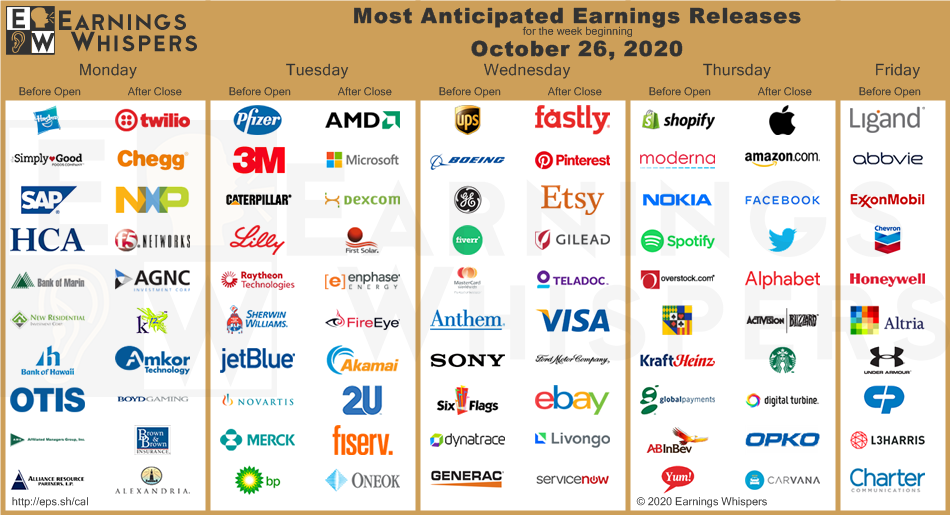
Week of Oct 16, 2020 Weekly Recap & The Week Ahead

Tuesday, October 20th, 2020

There will not be any re-cap for the week of October 16 2020 for some needed R&R.
Have a good week.

The week ahead — Economic data from Econoday.com:
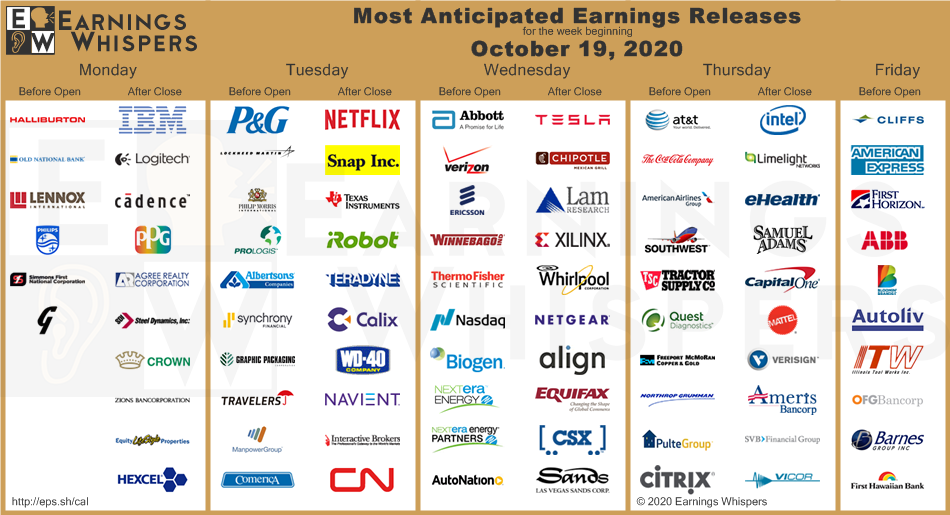
Week of Oct 9, 2020 Weekly Recap & The Week Ahead

Thursday, October 15th, 2020

The degree of risk present in a market derives from the behavior of the participants, not from securities, strategies, and institutions. — Howard Marks

1. Trump Returns to White House — President Donald Trump left Walter Reed Medical Center early last week and returned to the White House, where he will continue to be attended by physicians around the clock. The president continues to receive dexamethasone, the steroid that has shown to provide significant benefit to patients with severe cases of Covid-19. Trump received his fourth dose of the antiviral remdesivir before leaving and will receive his fifth and final dose outside the hospital.
2. Schools in New York City Hot Spots Will Close — with Covid-19 infections rising in some New York City neighborhoods, Gov. Andrew Cuomo said Monday that schools in several parts of Brooklyn and Queens would shutter in-person classes on Tuesday and move to fully remote instruction. The governor’s decision applies to nine of the city’s 146 ZIP Codes in parts of Far Rockaway and Kew Gardens in Queens, and Borough Park, Midwood, Gravesend, Bensonhurst, and Sheepshead Bay in Brooklyn. Gov. Cuomo also said that the state would start enforcing mask orders with fines, one of a number of items where he and the mayor appear to disagree.
3. Apple Expected to Unveil 5G Phones Next Week — Apple said that it would host a virtual event live from its Cupertino, Calif., headquarters on Tuesday, Oct. 12. The company didn’t say what precisely the event would focus on, but it is widely expected to roll out new 5G phones. Some analysts are calling the soon-to-be unveiled generation of Apple phones the iPhone 12, but the company might not stick with its numbering system. The new iPhone lineup is expected to include a 5.4-inch iPhone, a 6.1-inch iPhone Max, a 6.1-inch iPhone Pro, and a 6.7-inch iPhone Pro Max.
4. Judges Rule That Manhattan D.A. Can Obtain Trump Tax Records — Manhattan District Attorney Cyrus Vance can enforce a subpoena for President Donald Trump’s personal and business tax returns, according to a unanimous ruling from a three-judge appeal panel. The district attorney’s subpoena covers not just Trump’s personal and corporate tax records, but also communication he had with his accounting firm, Mazars. Early this summer, the Supreme Court rejected the president’s claim that he should have immunity from criminal investigation but left the door open for him to continue his fight against the wide scope and possible relevance of the documents covered by the subpoena.
5. Trump Raises Coronavirus Stimulus Offer to $1.8 Trillion — the White House will increase its coronavirus stimulus offer to $1.8 trillion, about $400 billion less than the $2.2 trillion bill Democrats previously passed. The plan would mark an increase from the $1.6 trillion the Trump administration previously proposed. House Democrats passed a $2.2 trillion bill earlier this month, and the sides have struggled to find a consensus in between those figures.

The week ahead — Economic data from Econoday.com:
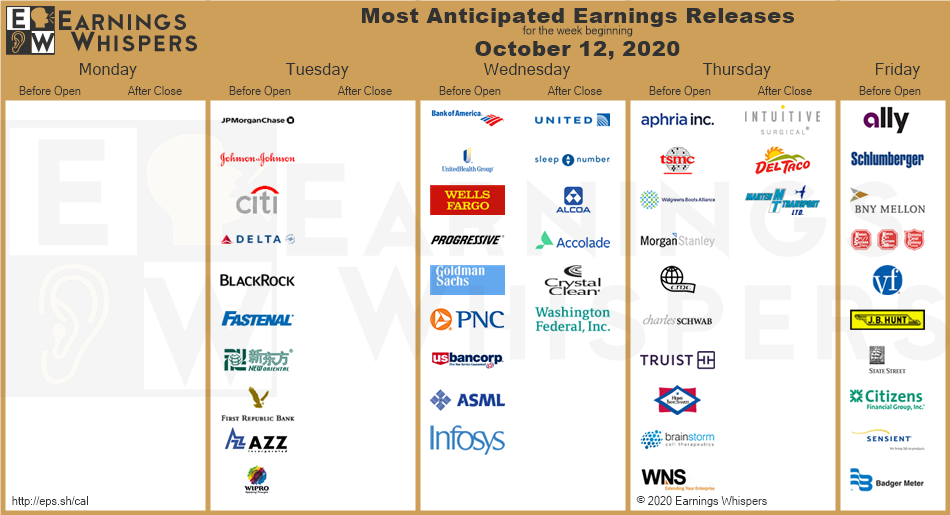
Week of Oct 2, 2020 Weekly Recap & The Week Ahead

Tuesday, October 6th, 2020

In dealing with the future, we must think about two things: (a) what might happen and (b) the probability that it will happen. — Howard Mark

1. Disney Will Lay Off 28,000 Staff at Theme Parks — Walt Disney Co. said it would lay off about 28,000 employees at its domestic theme parks, making the announcement shortly after the state of California signaled that Disneyland Resort would likely have to remain closed for the foreseeable future due to Covid-19 concerns. Disneyland and California Adventure in Anaheim, Calif., remain shuttered while theme parks in Florida, Paris, Shanghai, Japan, and Hong Kong have reopened to limited capacity. The California Department of Public Health moved some counties to new “tiers” Tuesday allowing some businesses to reopen, but Disneyland’s home of Orange County did not make the cut due to a late spike in cases.
2. Boeing Readies to Consolidate Dreamliner Production to South Carolina — Boeing Co. will set plans this week to consolidate 787 Dreamliner assembly in South Carolina, people familiar with the matter said, ending production of that jetliner in Washington state as the coronavirus pandemic saps demand for aircraft. The decision carries significant implications for the Seattle-area economy and Boeing’s unionized workforce around Puget Sound. It wasn’t clear over what period of time the consolidation would play out, or how many employees might be affected by the move. Boeing could announce the plans. Furthermore, Boeing opted for a more muted come-back approach after a public scolding by the U.S. Federal Aviation Administration and private criticism from airlines over its handling of the Max crisis, the people said. With its reputation in tatters, Boeing is leaning on the FAA, pilots and airlines to assure travelers that the revamped Max is safe to fly. FAA Administrator Steve Dickson, a licensed 737 pilot, plans to flying a Max himself.
3. U.S. Airlines Started to Furloughing Employees — United Airlines, which is set to furlough about 16,000 employees, announced the move in mid-September, while urging Congress to extend the payroll support program for an additional six months. American Airlines is set to furlough about 19,000 workers. Delta and Southwest haven’t disclosed plans Relief payments from the federal government, doled out in April, were conditioned on the airlines refraining from conducting involuntary layoffs until the end of September. Delta, for instance, received more than $5 billion.
4. President Trump Tests Positive for Coronavirus — the president tweeted that he and first lady Melania Trump tested positive for the virus, a development that will upend the final month of the 2020 campaign. They plan to remain at the White House while they recover, and Mr. Trump will need to cancel in-person events in the coming weeks, possibly including the next debate against Joe Biden on Oct. 15 in Miami. Furthermore, Vice President Pence and his wife Karen both tested negative for coronavirus on Friday morning, according to a statement from Devin O’Malley, the vice president’s secretary. Pence is scheduled to have a debate with Democratic VP candidate Sen. Kamala Harris in Salt Lake City on Oct. 7.

The week ahead — Economic data from Econoday.com:
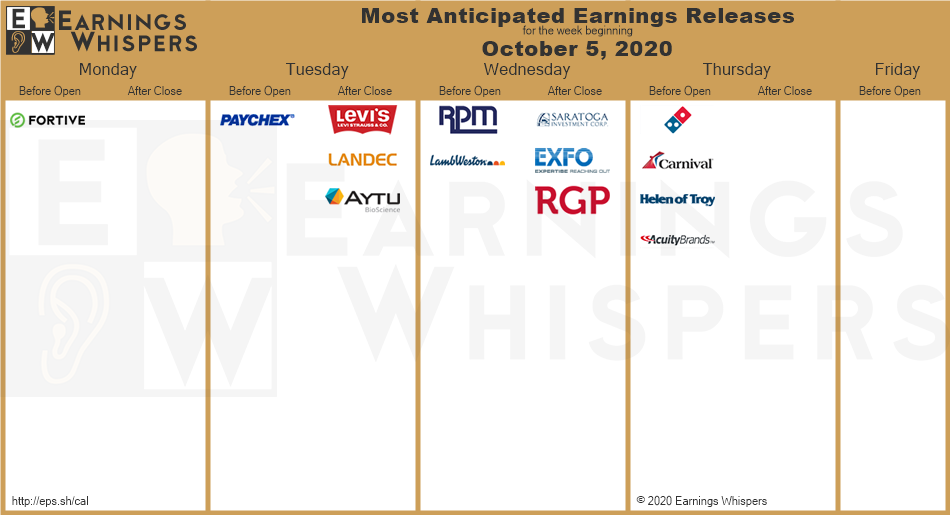
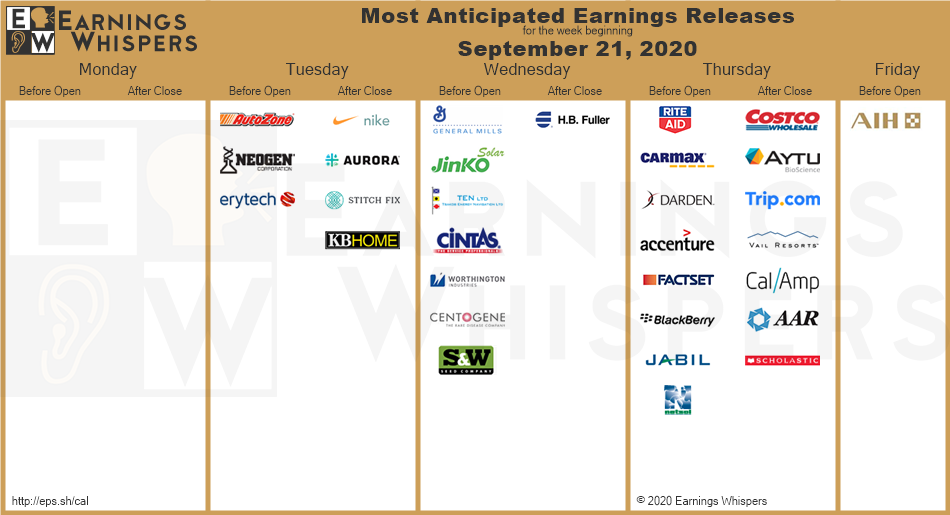
Week of Sept 25, 2020 Weekly Recap & The Week Ahead

Wednesday, September 30th, 2020

“Being too far ahead of your time is indistinguishable from being wrong.” So”
― Howard Marks

1. Details of TikTok Deal as Chinese Might Reject Deals — a state-run Chinese news outlet said Monday that the Chinese government would not approve the deal between Oracle, Walmart, and ByteDance, the parent company of popular video-sharing app TikTok. The deal under consideration would result in American investors owning 53% of TikTok Global, The Wall Street Journal reported. ByteDance, however, insists that it would retain about 80% ownership of the newly created company.
2. A ‘Super V-Shaped’ Recovery in Housing — existing home sales hit their highest level in nearly 14 years in August, with the seasonally-adjusted annual rate reaching 6 million for the first time since December 2006, data released Tuesday by the National Association of Realtors showed. Those buyers are mostly looking for bigger houses—a dynamic driven by increased work-from-home arrangements as well as children doing remote classwork.
3. Trump Signs Executive Orders on Health Care — President Trump signed two executive orders late on Thursday, which he said would provide better protection for people with pre-existing health problems, at a lower cost than provided for under the Affordable Care Act. Trump also said that 33 million Medicare recipients would be sent cards in the mail to cover up to $200 in prescription drug costs. Details of the plan were light.
4. U.S. New-Home Sales Climb to 1 Million Rate, Fastest Since 2006 — Sales of new homes in the U.S. unexpectedly advanced for a fourth month in August to the highest level in almost 14 years as record-low mortgage rates continued to entice buyers into a market with ever-shrinking supply. Purchases of new single-family houses increased 4.8% to a 1 million annualized pace, led by a flurry of demand in the South, after an upwardly revised 14.7% surge in July, government data showed. The median selling price decreased from a year earlier to $312,800 and the number of homes for sale dropped to an almost three-year low.

The week ahead — Economic data from Econoday.com:
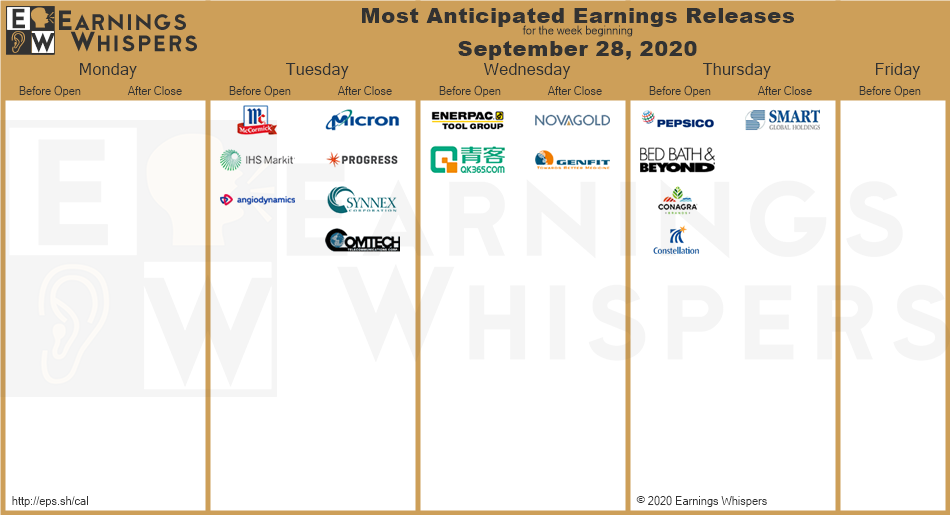
Week of Sept 18, 2020 Weekly Recap & The Week Ahead

Tuesday, September 22nd, 2020

Most people are driven by greed, fear, envy, and other emotions that render objectivity impossible and open the door for significant mistakes. — Howard Marks

1. House to Introduce Bipartisan Stimulus Bill — after months of failed negotiations, 50 moderate House Republicans and Democrats will unveil a $1.5 trillion coronavirus stimulus plan. According to The Wall Street Journal, moderate Democrats have urged Pelosi to resume negotiations with the White House. Pelosi has not ruled out a deal and the Journal reports that the White House would accept a package with a $1.5 trillion price tag. The House bill from the bipartisan group is expected to include around $500 billion for state and local governments, per Bloomberg. It will also include additional unemployment benefits and another round of stimulus payments for most Americans.
2. Amazon Expands Its Pandemic-Era Hiring Spree — Amazon will hire 100,000 warehouse workers in the U.S. and Canada to help keep up with surging demand due to the Covid-19 pandemic.
Amazon says hiring is already under way and that the jobs pay at least $15 an hour with benefits and come with a $1,000 signing bonus in some locations. Separately, the company is hiring for some 30,000 corporate and technology jobs, with an average compensation of $150,000. Other retailers that have profited during the pandemic are hiring as well. For example, Walmart has hired 200,000 new employees and Chipotle announced in July that it will hire 10,000 workers to open new locations and staff drive-thru lanes for online orders.
3. U.S. Retail Spending Grew at Slower Pace in August — U.S. retail spending rose 0.6% in August for the fourth straight monthly increase, but at a slower pace as some extra unemployment benefits ran out. Consumers spent more on clothing, electronics and furniture in August as students went back to school, many for online classes because of the pandemic. Spending fell on groceries and sporting goods. Some retailers say that consumers who are still working from home have continued spending on home improvement, including their workspaces, and purchased big-ticket items with money saved from not dining out or traveling.
4. Fed Signals Rates Will Stay Near Zero for at Least Three Years — the Federal Reserve left interest rates near zero and signaled it would hold them there through at least 2023 to help the U.S. economy recover from the coronavirus pandemic. The Federal Open Market Committee “expects to maintain an accommodative stance of monetary policy” until it achieves inflation averaging 2% over time and longer-term inflation expectations remain well anchored at 2%. In addition to slashing borrowing costs in March, the central bank has pumped trillions of dollars into the financial system through bond purchases and launched a slew of emergency lending facilities to keep businesses afloat. The economy has partly recovered from the steepest downturn on record and some sectors such as housing are doing well, but Covid-19 continues to kill thousands of Americans each week, unemployment remains high and industries like hospitality and travel are depressed.

The week ahead — Economic data from Econoday.com:
Search
Calendar
February 2026
M T W T F S S
« Jan    
 1
2345678
9101112131415
16171819202122
232425262728  
Archives
Categories
The information provided by The EGS Blog is based on sources believed to be reliable, but it is not guaranteed to be accurate. There is no guarantee that the recommendations of The EGS Blog will be profitable or will not be subject to losses. The information provided by The EGS Blog is not a recommendation or a solicitation that any particular investor should purchase or sell any particular security in any amount, or at all. The investments discussed or recommended herein may be unsuitable for investors depending on their specific investment objectives and financial position. At any time EGS LLC and its principals may maintain positions that are contrary to positions announced within the subscription service. In no event will The EGS Blog be liable to you or anyone else for any incidental, consequential, special, or indirect damage (including but not limited to lost profits or trading losses). PAST PERFORMANCE IS NO GUARANTEE OF FUTURE RESULTS

© Copyright 2026 Market Outlook All Rights Reserved
Design by EGS Sponsored by Equity Guidance LLC