Archive for the ‘Weekly Summary’ Category

Week of June 25, 2021 Weekly Recap & The Week Ahead

Monday, June 28th, 2021

“The last four and a half years have been carefree, halcyon times for investors. That doesn’t mean it’ll stay that way. I’ll give Warren Buffett the last word, as I often do: “It’s only when the tide goes out that you find out who’s been swimming naked.” Pollyannas take note: the tide cannot come in forever.”
― Howard Marks

1. U.S. Existing Home Sales Fell for a Fourth Straight Month in May — contract closings decreased 0.9% from the prior month to an annualized 5.8 million, according to data out Tuesday from the National Association of Realtors. The median forecast in a Bloomberg survey of economists called for a 5.73 million rate in May. Home prices will likely remain elevated for some time as builders struggle to replace the deficit in existing homes with new builds. They cite high materials prices, supply shortages and a limited number of skilled workers as ongoing challenges. The median selling price rose 23.6% from a year ago to a record $350,300 in May.
2. Mideast Joins Bitcoin Craze With First Dubai Crypto Listing — the Canadian fund was the first of its type to be listed on a major exchange, in Toronto last year. The intent of the Dubai listing is to get trading at all hours around the globe. Dubai-based Dalma Capital Management Ltd. is the joint lead arranger for the offering. The Bitcoin Fund invests in long-term holdings of Bitcoin as a safer alternative to direct investments in the cryptocurrency, according to its prospectus. The fund does not speculate with regard to short-term changes in Bitcoin prices.
3. Fauci Calls Delta Variant the “Greatest Threat” to Defeating Coronavirus — Delta, first identified in India, is now about 20.6% of new U.S. cases and is expected to become the dominant strain, said Dr. Rochelle Walensky, director of the Centers for Disease Control and Prevention. Delta is estimated to be 60% more transmissible than the Alpha variant first identified in the U.K. Fauci said studies have shown that the Pfizer – BioNTech vaccine is 88% effective against the Delta variant two weeks after the second dose, and he urged Americans to get fully vaccinated to “crush the outbreak.”
4. Biden, Senators Agree to Roughly $1 Trillion Infrastructure Plan — President Biden and a group of centrist senators agreed to a roughly $1 trillion infrastructure plan, securing a long-sought bipartisan deal on overhauling the nation’s transportation, water and broadband infrastructure that lawmakers and the White House will now attempt to shepherd through a closely-divided Capitol Hill. Drafts of the agreement had called for $579 billion of spending above expected federal levels, totaling $973 billion over five years and $1.2 trillion if continued over eight. The lawmakers had discussed financing the package with a mix of public-private partnerships, existing federal funds, and revenue collected from enhanced enforcement at the Internal Revenue Service.
5. Hong Kong will ban all passenger flights from the United Kingdom starting July 1, 2021 — the government classified the U.K. as an “extremely high risk,” citing the rebound of the cases in the U.K. and the “widespread Delta variant virus strain there,” the Associated Press reported. People who have spent more than two hours in the U.K. will be prohibited from boarding passenger flights to Hong Kong. Hong Kong has one of the world’s strictest quarantine requirements for incoming passengers, and had recently increased quarantines for travelers from the U.K. to three weeks in hotel quarantine, The Financial Times reported. The Delta variant now makes up 99% of new cases in the U.K.

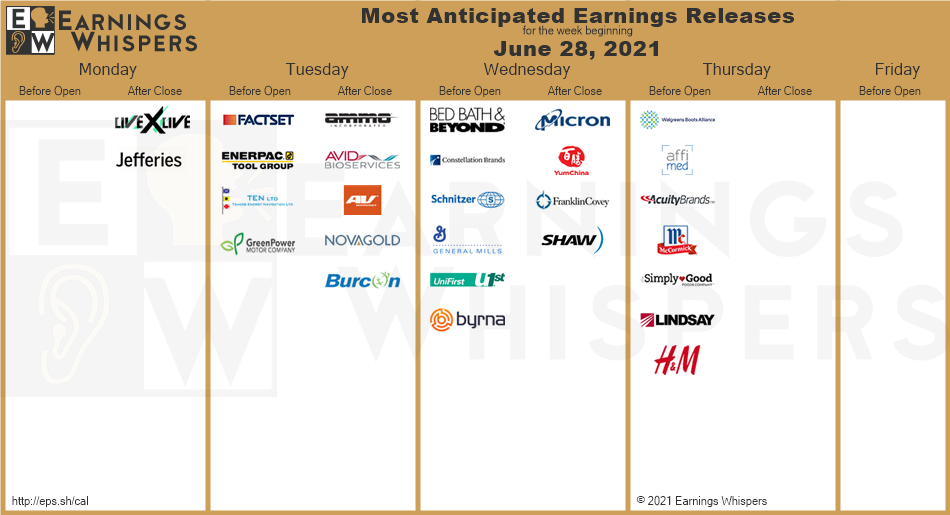
The week ahead — Economic data from Econoday.com:
Week of June 18, 2021 Weekly Recap & The Week Ahead

Monday, June 21st, 2021

“It ain’t what you don’t know that gets you into trouble. It’s what you know for sure that just ain’t so.”
― Howard Marks

1. U.S. Retail Sales Drop, Hinting at Shift to Spending on Services — the total value of retail purchases fell 1.3% in May following an upwardly revised 0.9% gain in April, Commerce Department figures showed Tuesday. The median estimate in a Bloomberg survey of economists called for a 0.8% decrease. For the last year, demand for goods has been propped up by elevated savings supported by fiscal stimulus, bringing total retail sales well above pre-pandemic levels. The May decline in retail sales suggests that as travel picks up and entertainment venues reopen, spending on goods is starting to moderate.
2. U.S. Talking to China on Boeing 737 Max Approval — The Biden administration is engaging with China in an effort to win approval for Boeing Co.’s 737 Max planes, which remain banned in the country even as other jurisdictions have reauthorized it following crashes. the two countries have yet to resume formal trade negotiations since President Joe Biden took office and initiated a broad review of China relations. Raimondo brought positive news for Boeing, with the U.S. and the European Union agreeing to extend a tariff truce for five years — parking a dispute over aircraft subsidies given to Airbus SE and Boeing that saw the allies impose duties on $11.5 billion of each other’s exports.
3. Fed Signals Earlier Interest-Rate Rise — Fed officials signaled interest rates will rise sooner and faster than previously expected, a surprise development that comes as inflation runs much hotter than officials have anticipated. Seven officials now expect to lift interest rates next year, up from four officials in March. More important: All but five members think rates will need to increase in 2023. In March, only 7 thought so, with 11 members expecting to keep rates pinned at zero. Markets have been expecting no change in rates before 2024. And more important still is the fact that five officials now see rates at 1% or higher in 2023, suggesting rates won’t just rise sooner but faster. The Fed’s statement Wednesday said it would continue buying $120 billion a month in Treasuries and mortgage-backed securities, but Powell opened the door to a tapering announcement during his press conference.

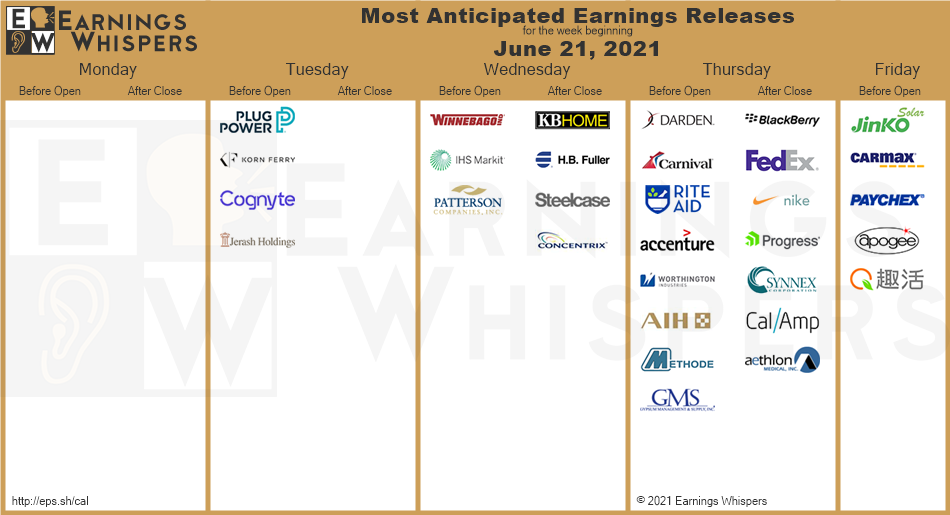
The week ahead — Economic data from Econoday.com:
Week of June 11, 2021 Weekly Recap & The Week Ahead

Tuesday, June 15th, 2021

“The desire for more, the fear of missing out, the tendency to compare against others, the influence of the crowd and the dream of the sure thing—these factors are near universal. Thus they have a profound collective impact on most investors and most markets. The result is mistakes, and those mistakes are frequent, widespread and recurring.”
― Howard Marks

1. Eli Lilly May Be a Big Winner From the FDA’s Alzheimer’s Decision — The company is developing its own Alzheimer’s therapy, called donanemab, which works along the same principles as Aduhelm. Analysts say the details of the FDA’s decision on Aduhelm may allow Lilly to file for approval for donanemab far sooner than expected. Eli lilly’s unveiling of data from a donanemab trial called Trailblazer-ALZ in March was a major event for investors. While the data showed that the drug had rapidly and dramatically cleared amyloid plaque, the brain buildup thought to have a role in Alzheimer’s disease, experts noted that that the slowing of cognitive decline seen in the study was not statistically significant by all measures.
2. U.S. Senate Is Poised to Pass China Bill — The U.S. Senate could soon pass a wide-ranging China bill that has bipartisan support for major investments to boost the country’s technology edge over China. The package focuses on bolstering U.S. leadership in areas like artificial intelligence, high-performance computing, and advanced manufacturing. The package also lays out funding to increase chip production domestically.
Other proposals range from trying to secure U.S. research and innovation at academic centers from foreign intervention to calling for a domestic boycott of the Winter 2022 Olympics in Beijing.
The package offers a framework for the evolving U.S.-China relationship on multiple fronts as policy makers try to find a balance between pushing back against China over human rights concerns and technology-related issues while avoiding damaging U.S. companies’ lucrative business in China.
3. Bipartisan Group of Senators Reaches Agreement on Infrastructure Proposal — Members of a bipartisan group of senators said they had reached an agreement on an infrastructure proposal that would be fully paid for without tax increases. While the group of 10 senators didn’t reveal details of the plan in its statement, people familiar with the agreement said it called for $579 billion above expected future federal spending on infrastructure. The overall proposal would spend $974 billion over five years and $1.2 trillion if it continued over eight years, according to some of the people.
4. U.S. Inflation Is Highest in 13 Years as Prices Surge 5% — The Labor Department said last month’s increase in the consumer-price index was the largest since August 2008, when the reading rose 5.4%. The core-price index, which excludes the often-volatile categories of food and energy, jumped 3.8% in May from the year before—the largest increase for that reading since June 1992. May’s jump in prices extends a trend that accelerated this spring amid widespread Covid-19 vaccinations, relaxed business restrictions, trillions of dollars in federal pandemic relief programs and ample household savings—all of which have stoked demand for Americans to spend and travel more.
Overall prices jumped at a 9.7% annualized rate over the three months ended in May. On a month-to-month basis, overall prices rose a seasonally adjusted 0.6% and core prices rose 0.7%.

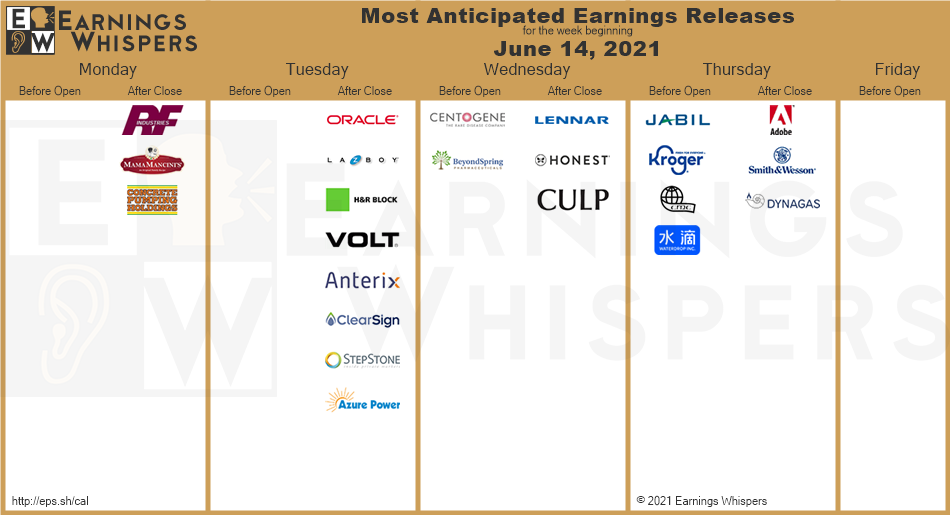
The week ahead — Economic data from Econoday.com:
Week of June 4, 2021 Weekly Recap & The Week Ahead

Monday, June 7th, 2021

June 4, 2021 Weekly Recap Will Not Be Published This Week; The Office is Closed for Some Needed R&R

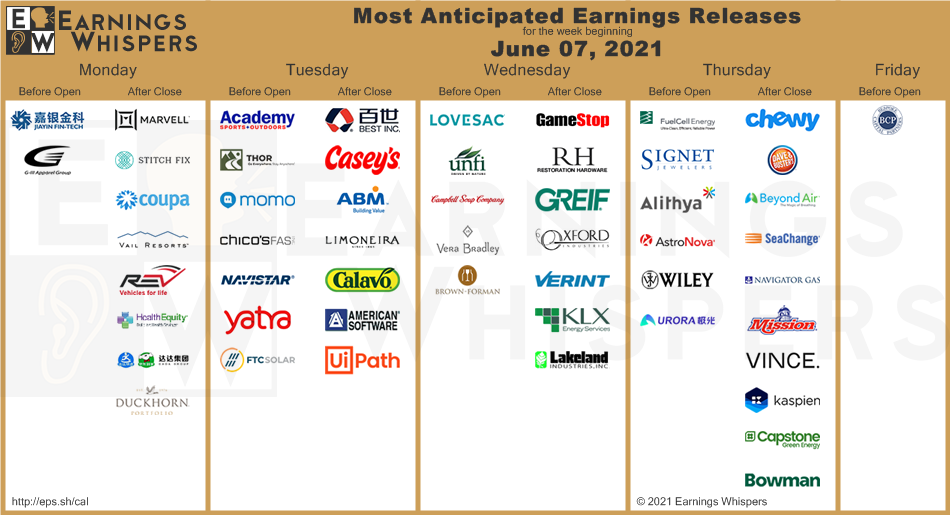
The week ahead — Economic data from Econoday.com:
Week of May 28, 2021 Weekly Recap & The Week Ahead

Tuesday, June 1st, 2021

1. GOP to Offer Biden Nearly $1 Trillion for Infrastructure Plan — Democratic lawmakers have warned that time is running short to determine whether a bipartisan deal on infrastructure is possible, with progressives already calling for a go-it-alone approach using fast-track budget procedures. A new offer around $1 trillion would still be well short of Friday’s $1.7 trillion proposal from the White House. On Friday, the Biden administration reduced its proposal by more than $500 billion from an initial $2.25 trillion by lowering spending on roads, bridges and broadband and saying he is willing to make investments in the manufacturing sector in separate bills — like the China-focused legislation on the Senate floor this week.
2. HSBC to Exit Unprofitable U.S. Retail Banking — HSBC, Europe’s second-largest bank by assets said it would sell most of its branches on the U.S.’s east and west coast to Citizens Bank and Cathay Bank, respectively, as part of a plan to implement some $4.5 billion of cost cuts, shed 35,000 jobs worldwide, and shift its main focus to Asia. The British-Asian bank is also in talks with U.S. private-equity fund Cerberus Capital Management to unload its loss-making French operations. HSBC lost $547 million in wealth management and personal banking in the U.S. last year, compared with the $5 billion profit it made in Hong Kong and the rest of Asia.
2. Amazon to Buy MGM for $6.5 Billion Excluding Debt — Amazon.com Inc. to buy James Bond movie company Metro-Goldwyn-Mayer, potentially taking one of the last major independent film studios off the market. The proliferation of streaming services, including newer arrivals such as Disney+, HBO Max and Paramount+, has put pressure on Amazon to acquire more programming. MGM’s vast backlog also provides plenty of material at a time when production of new shows and movies is still recovering from the pandemic.
4. Ford Announces $30 Billion Commitment to its Electric Vehicles Future — Ford Motor is expanding its commitment to vehicle electrification, surprising investors with plans to increase spending on electric vehicles to $30 billion by 2025. It added $8 billion to its previous spending goal, and said it will target the additional money for battery production.
Ford, which sold about 4.2 million vehicles in 2020, expects electric vehicles to be 40% of its sales by 2030. Some analysts say its electric-vehicle strategy has lagged behind General Motors and Volkswagen, which is providing its EV technology to Ford for future plug-in offerings in Europe.
5. Senate Republicans Block Jan. 6 Riot Commission — Senate Republicans blocked the creation of a bipartisan, independent commission to investigate the Jan. 6 assault on the U.S. Capitol by a pro-Trump mob, after GOP leaders urged colleagues to reject it. The bill needed 60 votes to advance in the evenly divided Senate, thanks to the chamber’s longstanding filibuster rule. That means 10 Republicans would have had to vote with all 50 members of the Democratic caucus to allow the bill to proceed. Only six did, and the legislation fell short, with 54 votes in favor and 35 against, with 11 senators not voting.
6. Biden Is Expected to Unveil $6 Trillion Spending Plan — the president is proposing a $6 trillion budget for fiscal year 2022, which begins Oct. 1, according to people familiar with the plans. That includes $1.52 trillion in discretionary spending for the military and domestic programs, including more funding for education, healthcare, research and renewable energy, White House officials said in April. Under the proposal, debt as a percentage of annual gross domestic product would within a few years exceed the level at the end of World War II and climb to 117% of GDP by the end of 2031, according to people familiar with the matter. That would be up from about 100% this year.

The week ahead — Economic data from Econoday.com:
Week of May 21, 2021 Weekly Recap & The Week Ahead

Monday, May 24th, 2021

“There are three ingredients for success—aggressiveness, timing and skill—and if you have enough aggressiveness at the right time, you don’t need that much skill.”
― Howard Marks

1. WarnerMedia’s Combination with Discovery Is the Latest Salvo in the Streaming Wars — WarnerMedia’s combination with Discovery creates the second-largest U.S. media company behind Walt Disney. Viacom and Comcast, the parent of NBCUniversal, will find themselves on the smaller end after the deal closes in terms of streaming scale, competing against their rivals’ bigger subscriber bases with their Paramount+ and Peacock offerings.
2. New York Drops Masks and Capacity Limits, a Potential Boon to Tourism — New York officially drops mask mandates for the vaccinated and capacity limits for everything from restaurants to museums and theaters on Wednesday, a potential boon to New York City’s economy as workers return to Midtown offices and tourists repopulate Times Square. More than 42% of all New Yorkers have been fully vaccinated as of Tuesday, and 12- to 15-year-olds became eligible for the Pfizer shots last week. Nearly 53% of the state’s adults are fully vaccinated. Tourists can get vaccinated in the city.
3. Fed Officials Discussed Tapering Bond Buying in the Latest Fed Minutes — The minutes related to the Federal Open Market Committee meeting at the end of April, before a weak report on the number of jobs added that month and before the April consumer-price index reported the fastest yearly increase since 2008. In the minutes, Fed officials noted elevated risk appetite in capital markets. “Should investor risk appetite fall, an associated drop in asset prices coupled with high business and financial leverage could have adverse implications for the real economy,” the minutes said. Supply chain bottlenecks and input shortages may not be resolved quickly, the minutes said, and could put upward pressure on prices.
4. Treasury Calls for Crypto Transfers Over $10,000 to Be Reported to IRS — The U.S. Treasury said the Biden administration’s proposal to strengthen tax compliance includes a requirement for transfers of at least $10,000 of cryptocurrency to be reported to the Internal Revenue Service. Cash transactions in excess of $10,000 are already subject to IRS reporting requirements.
The IRS in 2020 added a line about cryptocurrency on the Form 1040, the individual tax return, in an effort to gain more visibility into virtual currency transactions.

The week ahead — Economic data from Econoday.com:
Week of May 14, 2021 Weekly Recap & The Week Ahead

Tuesday, May 18th, 2021

May 14, 2021 Weekly Recap Will Not Be Published This Week; The Office is Closed for Some Needed R&R

The week ahead — Economic data from Econoday.com:
Week of May 7, 2021 Weekly Recap & The Week Ahead

Tuesday, May 11th, 2021

“Be patient and learn how to sit on your hands.” — Doug Kass

1. Fully Vaccinated Tourists Can Visit Europe This Summer — fully vaccinated travelers will be allowed to visit 27 European Union nations this summer under a travel proposal the European Commission. If approved, the policy would allow visitors from countries with low infection rates and proof of vaccination. The EU is creating a “Digital Green Certificate” to help governments more easily verify a completed vaccination, a negative test, or Covid recovery. Certificates will be in digital or paper form, include a QR code for authenticity, and contain limited personal data.
Canada is also considering a vaccine passport for travelers, perhaps as an upgrade to its ArriveCAN app for visitors to report their contact information, quarantine and travel plans, and symptoms. In one poll, 78% of Canadians said vaccine passports should be required of all inbound travelers.
2. U.S. to Back Waivers for Covid-19 Vaccine Patents — The U.S. government signaled Wednesday that it would support a temporary waiver for intellectual property rights on coronavirus vaccines, as advocated by the World Health Organization, in spite of the strong objections of the global pharmaceutical industry. The pharmaceutical industry has argued that waiving patents would not address the current manufacturing bottlenecks that explain vaccine shortages, and that it could hand crucial sensitive technology and scientific secrets to countries like Russia or China.
3. U.S. Births at Lowest in 41 Years on Pandemic Worries and Economic Uncertainty — the U.S. birthrate fell 4% in 2020, the sixth straight year of decline and the lowest since 1979, according to provisional data from the Centers for Disease Control and Prevention’s National Center for Health Statistics. The birthrate was hurt by pandemic worries, economic uncertainty, and postponed pregnancies. The average number of children American women might have over their lifetimes is 1.64, a record low. Fewer babies are being born than the number needed to replace people who are dying, the CDC said.
4. India’s Covid-19 Cases Top 400,000 Again, as Vaccinations Decline — India reported another 412,262 coronavirus cases, the second time in a week it has recorded more than 400,000 cases in 24 hours, per Johns Hopkins University data. India is home to 18% of the world’s population but accounted for 46% of new Covid-19 cases globally and one in four deaths this past week, the World Health Organization said Wednesday. India has vaccinated more than 30 million people, or 2.2% of its population. President Joe Biden supports sharing Covid-19 vaccine patents, but the European Union and other World Trade Organization nations would need to approve waiving intellectual property protections. Other countries would also need the facilities, techniques and ingredients to make vaccines.

The week ahead — Economic data from Econoday.com:
Week of Apr 30, 2021 Weekly Recap & The Week Ahead

Monday, May 3rd, 2021

“Try to get a little smarter every day and read as much as humanly possible. An investment in knowledge pays the best dividends” — Doug Kass

1. Fully Vaccinated Americans Will Be Able to Visit the European Union This Summer — European Commission President Ursula von der Leyen told the New York Times that “all 27 member states will accept, unconditionally, all those who are vaccinated with vaccines that are approved by E.M.A.” The European Medicines Agency has approved all three of the vaccines currently being given in the U.S. She didn’t provide a timeline or details on how travel would reopen, but said the United States was making “huge progress” toward reaching herd immunity of vaccinating at least 70% of its adult population by mid-June.
2. Fed Holds Steady on Interest Rates — the Federal Reserve held its key interest rate near zero and said it plans to continue supporting the economic recovery, while acknowledging recent progress in growth and employment. The Fed has held overnight interest rates near zero since March 2020, when the Covid-19 pandemic and related restrictions delivered a severe blow to the economy. Since June, the central bank has also been purchasing at least $80 billion of Treasury bonds and at least $40 billion of mortgage-backed securities to hold down longer-term borrowing costs for consumers and businesses.
Fed officials have said they would hold rates steady until the labor market is back to full strength and inflation has reached the central bank’s goal of averaging 2%. Chairman Jerome Powell has said those conditions are unlikely to materialize this year, and most Fed officials indicated last month that they expect to hold off on raising rates until 2024 at the earliest.
3. U.S. Recovery Gains Steam as Spending Fuels 6.4% GDP Growth — Gross domestic product expanded at a 6.4% annualized rate following a softer 4.3% pace in the fourth quarter, the Commerce Department’s preliminary estimate showed. Personal consumption, the biggest part of the economy, surged an annualized 10.7%, the second-fastest since the 1960s. The inflation-adjusted value of domestically produced goods and services climbed to an annualized $19.1 trillion, indicating GDP will soon eclipse the pre-pandemic peak of nearly $19.3 trillion.
4. Biden Tax Proposal Would Kick In at Over $500,000 for Couples — the new top 39.6% tax bracket, proposed in Biden’s “American Families Plan” on Wednesday, would encompass less than 1% of taxpayers, the official said, asking not to be named to speak in more detail beyond the White House’s outline. The official’s comment suggested that the new rate, up from the current 37%, would be applied from 2022. For Biden’s separate proposed increase in the capital gains tax rate to 39.6% from 20%, the administration said earlier this week that will apply to both singles and joint filers who make $1 million or more.

The week ahead — Economic data from Econoday.com:
Week of Apr 23, 2021 Weekly Recap & The Week Ahead

Monday, April 26th, 2021

“The more often a stupidity is repeated, the more it gets the appearance of wisdom,” — Doug Kass

1. Nvidia’s $40 Billion Deal for Arm Faces U.K. National-Security Probe — U.K. Digital Secretary Oliver Dowden on Monday invoked a little-used power to order the country’s antitrust agency to investigate the merger’s national-security implications and deliver a report by July 30. The secretary can eventually clear the deal, with or without conditions, or nix it. The U.K. probe is the latest example of how governments around the world are increasingly tightening control over semiconductor technology, after the past year demonstrated how access to advanced microprocessors can make or break some of their biggest companies.
2. Biden Wants to Cut Greenhouse Gas Emissions in Half by 2030 — Biden will call for reducing emissions to 50% of their level in 2005 as part of global efforts to fight climate change. Emissions fell by 21% from 2005 levels during the pandemic, but are ticking higher again this year as the economy recovers. Biden invited 40 world leaders to the White House event, including Russian President Vladimir Putin. The invitees include 17 countries responsible for 80% of global greenhouse gas emissions. More than 300 companies, including Apple, Walmart and Johnson & Johnson, sent Biden a letter last week saying they were in favor of cutting emissions by at least 50%, while others worry Biden’s policies will harm the economy.
3. Intel CEO Sees Prolonged Chip-Supply Constraints — Pat Gelsinger, Intel CEO, said the supply constraints that have affected some sectors of the global economy for months will continue until more capacity comes online to meet chip demand for everything from automobiles to electronics. Mr. Gelsinger this month laid out an ambitious strategy for Intel to become a major contract chip maker in addition to making semiconductors to satisfy its in-house requirements. The plan includes a $20 billion spending commitment to build two new semiconductor plants in Arizona.
4. J&J Covid-19 Vaccine Pause Over Blood-Clot Fear Is Under Review — J&J vaccine injections were put on hold last week after reports of rare blood-clot conditions in a small number of recipients, including at least three fatalities. Many public-health authorities, however, contend that the benefits of the vaccine outweigh the risks. Anthony Fauci, President Biden’s chief medical adviser, has predicted the U.S. pause would end as soon as Friday, perhaps with new restrictions or warnings. A recommendation to lift the pause—and agreement by the FDA and CDC—could put the vaccine back in circulation as early as this weekend, because millions of doses have already been distributed to vaccine sites.
5. Biden Eyeing Tax Rate as High as 43.4% in Next Economic Package — For those earning $1 million or more, the new top rate, coupled with an existing surtax on investment income, means that federal tax rates for wealthy investors could be as high as 43.4%. The new marginal 39.6% rate would be an increase from the current base rate of 20%, the people said on the condition of anonymity because the plan is not yet public. A 3.8% tax on investment income that funds Obamacare would be kept in place, pushing the tax rate on returns on financial assets higher than rates on some wage and salary income, they said. Other measures that the administration has discussed in recent weeks include enhancing the estate tax for the wealthy. Biden has warned that those earning over $400,000 can expect to pay more in taxes. The White House has already rolled out plans for corporate tax hikes, which go to fund the $2.25 trillion infrastructure-focused “American Jobs Plan.”

The week ahead — Economic data from Econoday.com:
Search
Calendar
February 2026
M T W T F S S
« Jan    
 1
2345678
9101112131415
16171819202122
232425262728  
Archives
Categories
The information provided by The EGS Blog is based on sources believed to be reliable, but it is not guaranteed to be accurate. There is no guarantee that the recommendations of The EGS Blog will be profitable or will not be subject to losses. The information provided by The EGS Blog is not a recommendation or a solicitation that any particular investor should purchase or sell any particular security in any amount, or at all. The investments discussed or recommended herein may be unsuitable for investors depending on their specific investment objectives and financial position. At any time EGS LLC and its principals may maintain positions that are contrary to positions announced within the subscription service. In no event will The EGS Blog be liable to you or anyone else for any incidental, consequential, special, or indirect damage (including but not limited to lost profits or trading losses). PAST PERFORMANCE IS NO GUARANTEE OF FUTURE RESULTS

© Copyright 2026 Market Outlook All Rights Reserved
Design by EGS Sponsored by Equity Guidance LLC