Archive for the ‘Weekly Summary’ Category

Week of Aug 19, 2022 Weekly Recap & The Week Ahead

Monday, August 22nd, 2022

“It is not the strongest or the most intelligent who will survive but those who can best manage change.” – Charles Darwin

1. Biden Signs Bill Aimed at Lowering Drug Costs, Boosting Renewable Energy — President Biden signed into law sweeping legislation to lower prescription drug prices, boost the renewable energy sector and impose new taxes on large corporations. The package includes hundreds of billions of dollars in subsidies for investing in renewable-energy projects and producing energy from renewable sources—and includes credits to help factories retool to turn out electric vehicles or other products needed in a low-carbon economy. It also includes tax credits to help homeowners upgrade their homes with more energy-efficient products. It gives a $7,500 tax credit for purchasing electric vehicles, although with conditions that could make it hard to qualify. The law creates a new 15% corporate minimum tax and a 1% excise tax on companies’ stock buybacks and sets aside roughly $300 billion for reducing the deficit. And it spends $80 billion over a decade on new workers and technology at the Internal Revenue Service.
2. Fed Minutes Show Fed Sees Interest Rate Hikes Continuing Until Inflation Eases Substantially — Federal Reserve officials at their July meeting indicated they likely would not consider pulling back on interest rate hikes until inflation came down substantially, according to minutes from the session released last week. They did not provide specific guidance for future increases and said they would be watching data closely before making that decision. Market pricing is for a half-point rate hike at the September meeting, though that remains a close call.
Meeting participants noted that the 2.25%-2.50% range for the federal funds rate was around the “neutral” level that is neither supportive nor restrictive on activity. Some officials said a restrictive stance likely will be appropriate, indicating more rate hikes to come.
3. U.S. Home Sales Dropped in July for Sixth Straight Month — U.S. existing home sales fell in July for the sixth straight month, the longest streak of declines in more than eight years, as higher mortgage rates and a shortage of homes for sale are cooling this once red-hot market.
Sales of previously owned homes dipped 5.9% in July from the previous month to a seasonally adjusted annual rate of 4.81 million, the National Association of Realtors said Thursday. That was the weakest pace of sales since November 2015, excluding the three-month pandemic-related drop in the spring of 2020. July sales tumbled 20.2% from a year ago. sales are slowing and the relentless rise in home prices is showing some signs of easing after repeated new highs. The median sales price of an existing home fell to $403,800 from a record $413,800 in June, the first decline since January, according to NAR.
4. U.S. Plans to Shift Bill for Covid Shots and Treatments to Insurers, Patients — The Biden administration is planning for an end to its practice of paying for Covid-19 shots and treatments, shifting more control of pricing and coverage to the healthcare industry in ways that could generate sales for companies—and costs for consumers—for years to come.
The Department of Health and Human Services intends to hold a planning session on Aug. 30 that would bring together representatives from drugmakers, pharmacies and state health departments with a stake in a Covid-19 treatment industry. Shifting payments for Covid-19 drugs and vaccines to the commercial market is expected to take months, an HHS spokesman said. At the meeting this month, officials and company representatives are expected to discuss reimbursement and coverage, regulatory issues and access to vaccines and treatment for the uninsured.

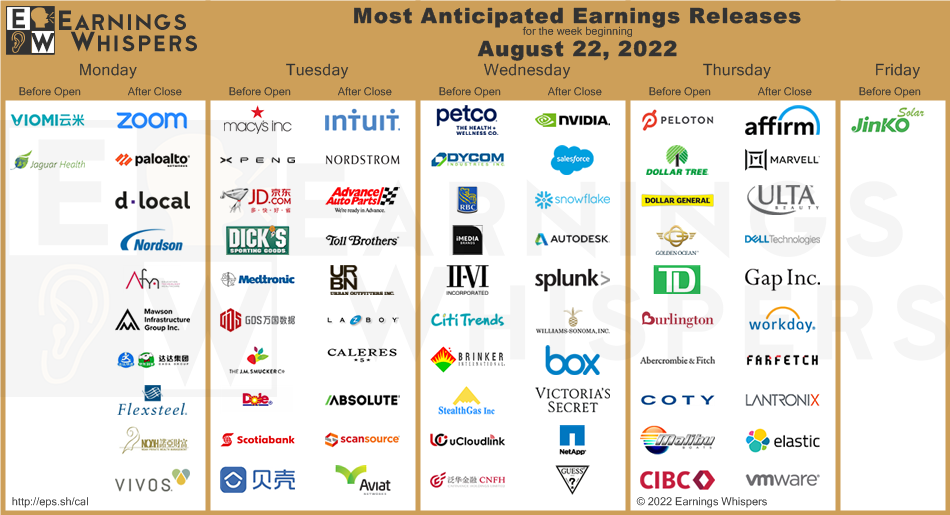
The week ahead — Economic data from Econoday.com:
Week of Aug 12, 2022 Weekly Recap & The Week Ahead

Monday, August 15th, 2022

“The biggest risk is not taking a risk. In a world that’s changing really quickly, the only strategy that is guaranteed to fail is not taking risks.” – Mark Zuckerberg

1. U.S. Productivity Falls for Second Straight Quarter — U.S. nonfarm labor productivity—a measure of goods and services produced in the U.S. per hour worked—fell at a seasonally adjusted annual rate of 4.6% in the second quarter from the prior quarter, the Labor Department reported. Economists surveyed by The Wall Street Journal had estimated a drop of 5%. Quarterly productivity figures are volatile, but the weak second-quarter number follows a 7.4% pullback in the first quarter, the sharpest drop in 74 years. Together with rising labor costs, the report points to the challenges for the Federal Reserve’s efforts to tamp down inflation that is running at a four-decade high.
2. House Passes Democrats’ Climate, Healthcare and Tax Package — the House passed a climate and healthcare bill Friday that will soon head to President Biden’s desk, the culmination of a yearlong push Democrats hope will motivate their voters in the midterm elections but that Republicans cast as harmful government overreach.
The party-line 220-207 vote comes less than a week after the Senate passed the measure. It imposes new taxes on large, profitable corporations, spends $87 billion over a decade on new workers and technology at the Internal Revenue Service, caps insulin costs for Medicare recipients, puts Medicare on course to negotiate drug prices and funds hundreds of billions in tax subsidies intended to combat climate change.
3. Pace of U.S. Inflation Eased in July as Energy Costs Dropped — the Labor Department reported the consumer-price index, a measure of what consumers pay for goods and services, rose 8.5% in July from the same month a year ago, down from 9.1% in June. June marked the fastest pace of inflation since November 1981. On a monthly basis, the CPI was flat in July after rising for 25 consecutive months, the result of falling energy prices such as gasoline. Core CPI, which excludes often volatile energy and food prices, eased to 0.3% last month, down sharply from June’s 0.7% gain. Price pressures abated across energy categories, with gasoline down 7.7% in July from the prior month. Used-car prices, up sharply earlier in the pandemic, also dropped on a month-to-month basis, as did airline fares and apparel.
4. U.S. Jobless Claims Rise Slightly to New 2022 High — initial jobless claims, a proxy for layoffs, increased to a seasonally adjusted 262,000 last week from a revised 248,000 the previous week, the Labor Department reported. The weekly number has been on an upward trend since reaching a 50-year low in March. ontinuing claims, a proxy for the number of people receiving government unemployment payments, increased by 8,000 to 1.43 million in the week ended July 30. Continuing claims are reported with a one-week lag.
The new figures come as other signs indicate that the U.S. labor market remains strong even though the U.S. economy shrank in the first two quarters of this year, according to the Commerce Department, as rising interest rates and inflation took steam out of business and consumer spending.

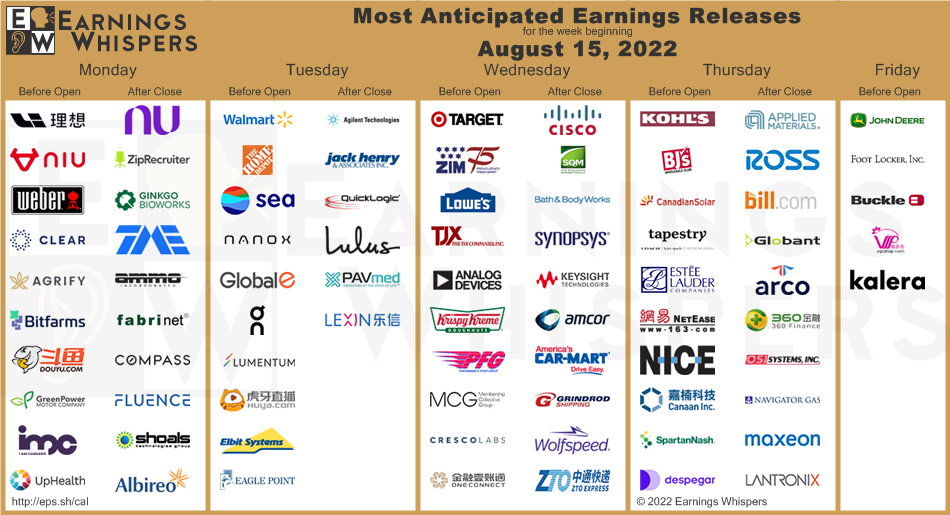
The week ahead — Economic data from Econoday.com:
Week of Aug 5, 2022 Weekly Recap & The Week Ahead

Monday, August 8th, 2022

THERE WILL NOT BE ANY POSTING FOR THE WEEK OF JULY 29TH 2022 — WE ARE AWAY FOR SOME NEEDED R&R

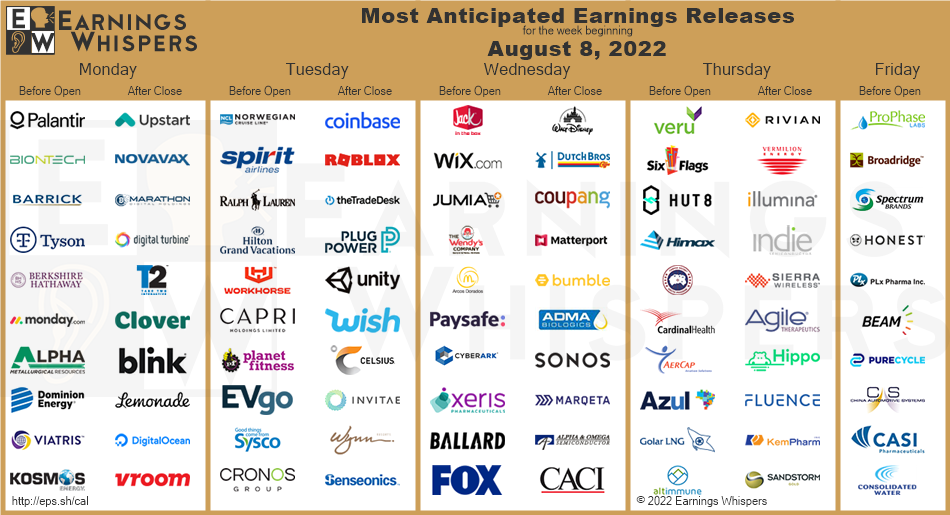
The week ahead — Economic data from Econoday.com:
Week of July 29, 2022 Weekly Recap & The Week Ahead

Monday, August 1st, 2022

The elements of good trading are: (1) cutting losses, (2) cutting losses, and (3) cutting losses. If you can follow these three rules, you may have a chance. — Ed Seykota

1. Senate Advances $280 Billion Bill Subsidizing Chip Manufacturing, Technology — the Senate voted 64 to 32 last week to advance a $280 billion package of subsidies and research funding to boost U.S. competitiveness in semiconductors and advanced technology. The package is set to give a big boost to domestic chip production, seen by the White House and leaders in both parties as critical to the U.S. supply chain and national security, as most semiconductors are imported from overseas. Shortages have also helped drive prices sharply higher for cars and other goods in recent years, and proponents say the bill will help cool consumer costs. The bill combines about $52 billion in subsidy funding to boost semiconductor production in the U.S., along with about $24 billion in advanced manufacturing tax credits that would also support the industry.
The package would authorize about $200 billion in spending, mainly for federally backed scientific research over the next decade. It would fund about $1.5 billion for next-generation wireless research and establish new long-term policies for the nation’s space program.
2. Fed Raises Interest Rates by 0.75 Percentage Point — officials agreed to a 0.75-percentage-point rate rise, which will lift their benchmark federal-funds rate to a range between 2.25% and 2.5%. The rate increase won unanimous backing from the 12-member rate-setting committee. The statement repeated language from previous meetings that said officials anticipate additional rate increases will be appropriate. “The labor market is extremely tight and inflation is much too high,” Fed Chairman Jerome Powell said at a news conference late last week.
3. U.S. GDP Fell at 0.9% Annual Rate in Second Quarter — Gross domestic product, a broad measure of the goods and services produced across the economy, fell at an inflation and seasonally adjusted annual rate of 0.9% in the second quarter, the Commerce Department said Thursday. That marked a deterioration from the 1.6% rate of contraction recorded in the first three months of 2022. The GDP report offered some discouraging signs, and underscored the challenges facing U.S. businesses, consumers and policy makers—including high inflation, weakening consumer sentiment and supply-chain volatility.
Consumer spending accounts for roughly two-thirds of total economic output, and Thursday’s report showed Americans spent at a cooler clip in the second quarter. Business investment worsened slightly. The housing sector slowed as borrowing costs rose.

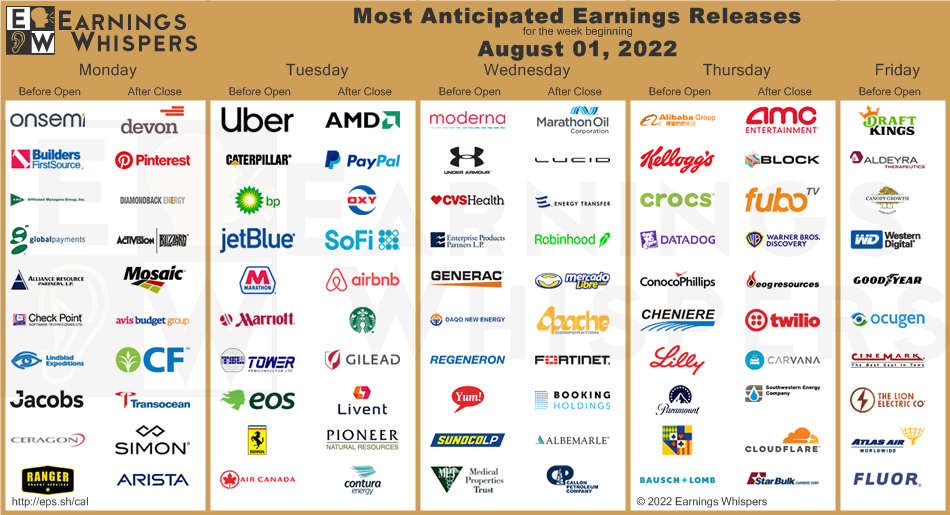
The week ahead — Economic data from Econoday.com:
Week of July 22, 2022 Weekly Recap & The Week Ahead

Monday, July 25th, 2022

“Knowledge born from actual experience is the answer to why one profits; lack of it is the reason one loses” — Gerald M. Loeb

1. Market Rout Shows Dangers of Margin Lending, Crypto Style — margin loans are one of the most common sources of the borrowed money, or leverage, that underlies the zigs and zags of financial markets. During the current winter for crypto firms and their investors, leverage is exposing crypto lenders’ risk-management failures and exposing many of their customers to significant losses and stressful uncertainty. In crypto, the legal and regulatory structures are far less developed. It isn’t always clear what a crypto lender can do with a counterparty’s collateral once it moves to liquidate. Lenders and the investment firms that borrow from them tend to have a much less-complete picture of each others’ finances than, say, a big bank like Goldman Sachs Group Inc. and its hedge-fund clients, said Richard Lee, a partner at Crowell & Moring LLP.
2. EU Seeks 15% Cut in Gas Use on Russian Supply Squeeze — the European Union proposed that the bloc cut its natural gas consumption by 15% over the next eight months in a plan that would affect all households, power producers and industry. The move reflects mounting concern that Russia will halt gas exports to the region in retaliation for sanctions following its invasion of Ukraine. A cutoff would threaten EU efforts to replenish stockpiles ahead of winter, potentially jeopardizing security of supply to key sectors and crippling the region’s economy well into next year.
3. Russia Resumes Nord Stream Natural-Gas Supply to Europe — Russian natural gas began flowing again at a reduced volume through a critical pipeline into Europe on Thursday, buying time for governments to decouple from the Kremlin’s exports amid what they expect will be an increasingly unreliable supply of energy from Moscow heading into the winter.
The Nord Stream pipeline connecting Russia with Germany under the Baltic Sea resumed operation after its annual maintenance, ending 10 days of tense speculation about whether President Vladimir Putin’s regime would cut off the gas flow to Europe in retaliation for Western sanctions after his invasion of Ukraine.
Gas-flow data showed the pipeline was operating at its premaintenance level of around 40% of total capacity.
4. ECB Raises Rates by Half-Percentage Point in First Hike Since 2011 — the European Central Bank raised interest rates by a larger-than-expected half-percentage point and unveiled a new plan to buy the debt of Europe’s most vulnerable economies, seeking to protect the currency union as it navigates the twin threats of skyrocketing inflation and slowing economic growth. The rate increase comes despite rapidly accumulating challenges facing Europe’s economy and the currency union’s cohesion—from a looming energy crisis to a protracted war next door, mounting political instability at home, and what many economists think has become an inevitable recession. Some of these could make it difficult for the ECB to focus on combating inflation.

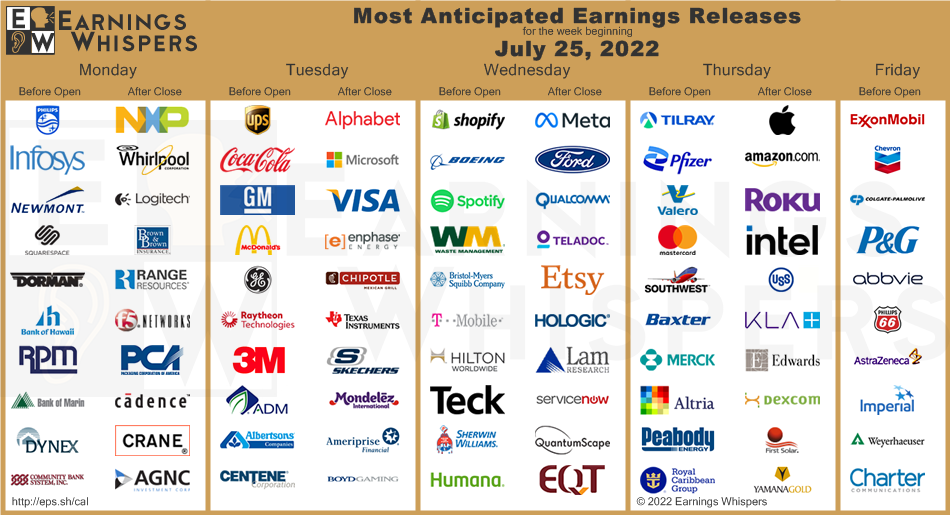
The week ahead — Economic data from Econoday.com:
Week of July 15, 2022 Weekly Recap & The Week Ahead

Monday, July 18th, 2022

“The key during a crisis is to be (a) insulated from the forces that require selling and (b) positioned to be a buyer instead.” ― Howard Marks

1. Housing Could Provide More Fuel for Inflation — Overall annual inflation rose to 8.6% in May, while core inflation, which excludes volatile food and energy costs, hit 6%, according to the Labor Department’s consumer-price index. The June figures are set to be released Wednesday. Rising fuel costs and supply-chain disruptions from Russia’s war against Ukraine added to inflation that was already high due to surging demand from the economy’s reopening and aggressive government stimulus. Annual housing inflation, as measured in the CPI, hit a recent low in early 2021 at 1.4% and it has since rebounded, to 5.4% in May, well above the annual average of 3.5% between 2015 and 2019.
2. U.S. Inflation Hits New Four-Decade High of 9.1% — U.S. consumer inflation rose to a new four-decade high at an annual rate of 9.1% in June, extending a year and a half stretch of persistently higher prices.
The consumer-price index’s rate of increase last month was the highest since December 1981, the Labor Department reported. It also eclipsed May’s annual rate of 8.6% that led Federal Reserve officials to shift to a faster pace of benchmark interest-rate increases in its campaign to bring down inflation. Core prices, which exclude volatile food and energy components, increased by 5.9% in June from a year earlier, slightly less than May’s 6.0% gain, the Labor Department said. The report likely keeps the Fed on track to raise its benchmark interest rate by 0.75 percentage point at its meeting later this month.
3. Euro Slips Below Dollar as Europe’s Economic Fortunes Slump — the euro’s slide below parity with the U.S. dollar reflects Europe’s sinking economic fortunes in the face of the war in Ukraine. But unlike the last time the euro was this weak 20 years ago, nobody is coming to the common currency’s rescue. Reaching parity—when two currencies are equal in value—is largely symbolic for investors, and is expected to have a limited impact on financial markets. But a weak euro does affect the region’s economy. It drives up the cost of imports and fans Europe’s already high inflation rate while making what Europe exports cheaper in international markets.
4. U.S. Retail Sales Rose 1% in June — consumers spent more last month across a range of goods that also surged in price, including gasoline, groceries and furniture. They also spent more at restaurants, as dining out became more expensive. Recent economic figures paint a mixed picture on the state of the economy, fueling an uncertain outlook and growing fears that a recession is looming. The Federal Reserve is also under pressure to raise rates aggressively to bring down high inflation. Manufacturing output fell for the second straight month in June, the Fed said Friday. Consumer sentiment in early July held near the lowest level on records, with nearly half of surveyed consumers blaming inflation for eroding their living standards, the University of Michigan’s index of consumer sentiment said. Home construction is also slowing.

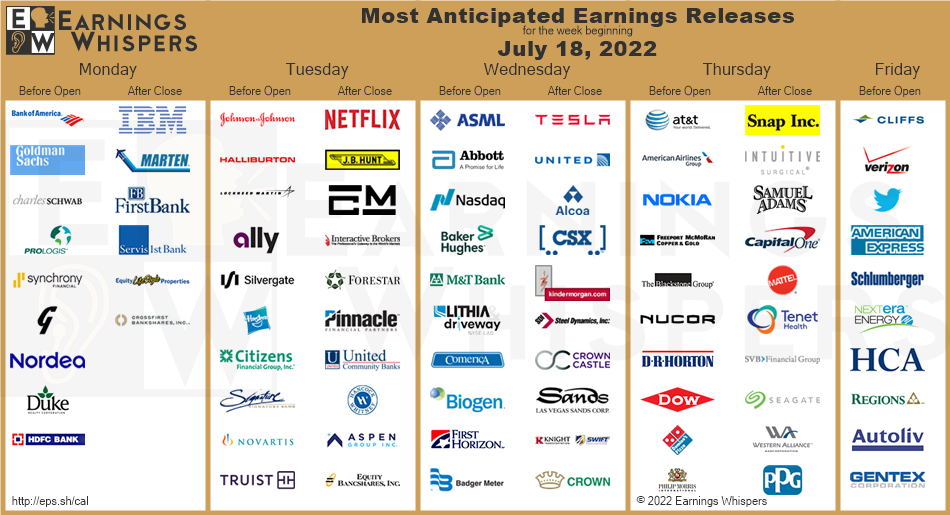
The week ahead — Economic data from Econoday.com:
Week of July 8, 2022 Weekly Recap & The Week Ahead

Monday, July 11th, 2022

“Amateurs think about how much money they can make. Professionals think about how much money they could lose.” –Jack Schwager

1. Latest Fed Minutes Could Bolster Bets for 75 Basis-Point Hike in July — Chair Jerome Powell has said the Fed could hike by either 50 basis points or 75 basis points in July. He made the remarks at a June 15 press conference after policy makers raised rates by 75 basis points in the largest hike since 1994. Updated quarterly projections of the 18 policy makers show the median participant on the Federal Open Market Committee sees rates rising to 3.4% at year’s end and 3.8% next year, from a current target range of 1.5% to 1.75%.
2. Mortgage Rates Fall by Most Since 2008 on Recession Fears — the 30-year fixed-rate mortgage averaged 5.3% for the last week, according to according to data released by Freddie Mac. The drop in rates, alongside a a 5.4% drop in mortgage applications for the week ending July 1, reveals a broader cooling in the housing market.
3. Crypto Broker Voyager’s Marketing on Safety of Customer Accounts Draws FDIC Scrutiny — Voyager Digital Ltd. VOYG 0.00%▲ marketed its deposit accounts for cryptocurrency purchases as safe, protected by the nation’s banking insurance system in the event of a failure. Voyager froze all activity, including withdrawals on $350 million in customer deposits that are stored at Metropolitan Commercial Bank, a small New York bank. Voyager said customers would be able to access those dollars after “a reconciliation and fraud prevention process is completed.” Still, some customers online said they were only just learning their deposits weren’t insured by the Federal Deposit Insurance Corp. in the way they thought. Voyager had marketed the accounts as protected by that national safety net, an attractive pitch in the volatile world of cryptocurrency.
4. U.S. Added 372,000 Jobs in June — the U.S. economy added 372,000 jobs in June, the Labor Department said Friday. Hiring gains last month held near the previous three months, when companies added an average of nearly 400,000 workers, but slipped from higher totals early in the year. Employers hired across industries, with the government the only major category to shed jobs in June. Hiring continued in industries vulnerable to interest-rate increases and shifting consumer habits. For instance, construction firms, susceptible to a faltering housing market and higher mortgage rates, added jobs last month. Transportation and warehousing companies hired workers despite a spring pullback of consumer spending on goods. The strong employment figures released Friday keep the Federal Reserve on track to raise interest rates by 0.75 percentage point at its meeting later this month to cool high inflation.

The week ahead — Economic data from Econoday.com:
Week of July1st, 2022 Weekly Recap & The Week Ahead

Tuesday, July 5th, 2022

“In my view, the greatest way to optimize the positioning of a portfolio at a given point in time is through deciding what balance it should strike between aggressiveness and defensiveness. And I believe the aggressiveness/defensiveness balance should be adjusted over time in response to changes in the state of the investment environment and where a number of elements stand in their cycles.” ― Howard Marks

1. Russia Defaults on Foreign Debt for First Time Since Communist Revolution — the Russian government was unable to compensate creditors on about $100 million of interest denominated in dollars and euros after a 30-day grace period following the May 27 deadline expired. Although President Vladimir Putin’s administration has the funds, reserves at Russia’s central bank are frozen and the biggest commercial banks are unable to trade in international markets under sanctions following Moscow’s invasion of Ukraine in February. Bondholders themselves will probably want to wait before formally starting default proceedings in the hope of being paid back after the war is over. Declaring default now would force Russia to pay back the principle on the loans immediately, but the same sanctions preventing interest payments would also stop those payments as well.
2. U.S. Bans Russian Gold Imports, Blacklists State-Owned Rostec — the U.S. has banned imports of Russian gold, broadening sanctions against the country following the Kremlin’s invasion of Ukraine in February, the U.S. Treasury Department said Tuesday. The Treasury on Tuesday also blacklisted 70 groups, many of which the U.S. said are critical to Russia’s defense industrial sector, including state-owned defense conglomerate Rostec, as well as 29 Russians. The official ban on new imports of Russian gold comes as Moscow’s invasion of Ukraine continues into its fourth month. The U.S. and the U.K. announced the move on Sunday during a Group of Seven meeting in the Bavarian Alps, with the rest of the G-7 joining the ban. Gold is Russia’s second most valuable export after energy and “rakes in tens of billions of dollars,” President Biden tweeted.
3. Powell Says Fed Must Accept Higher Recession Risk to Combat Inflation — Federal Reserve Chairman Jerome Powell said he was more concerned about the risk of failing to stamp out high inflation than about the possibility of raising interest rates too high and pushing the economy into a recession. Mr. Powell said the central bank had to raise rates rapidly, even if that raises the risk of recession, to avoid a worse danger for the economy—of higher inflation becoming entrenched. He said the Fed didn’t have the luxury of moving rates up gradually because of concern that the recent period of high inflation may lead consumers and price setters to expect elevated prices to persist. Central banks across the globe are in a hurry to raise interest rates amid surging price pressures. Rising fuel costs and supply-chain disruptions from Russia’s war against Ukraine have sent prices higher in recent months. In the U.S., such increases are adding to inflation that was already high as demand surged last year from the reopening of the economy and aggressive government stimulus.
4. Markets Post Worst First Half of a Year in Decades — Accelerating inflation and rising interest rates fueled a monthslong rout that left few markets unscathed. The S&P 500 fell 21% through Thursday, suffering its worst first half of a year since 1970, according to Dow Jones Market Data. Investment-grade bonds, as measured by the iShares Core U.S. Aggregate Bond exchange-traded fund, lost 11%—posting their worst start to a year in history.
Stocks and bonds in emerging markets tumbled, hurt by slowing growth. And cryptocurrencies came crashing down, saddling individual investors and hedge funds alike with steep losses. investors seem to be in agreement about only one thing: More volatility is ahead. That is because central banks from the U.S. to India and New Zealand plan to keep raising interest rates to try to rein in inflation. The moves will likely slow down growth, potentially tipping economies into recession and generating further tumult across markets.

The week ahead — Economic data from Econoday.com:
Week of June 25, 2022 Weekly Recap & The Week Ahead

Monday, June 27th, 2022

“When the demand for goods increases relative to the supply, there can be “demand-pull” inflation. When inputs to production such as labor and raw materials increase in price, there can be “cost-push” inflation. Finally, when the value of an importing country’s currency declines relative to that of an exporting country, the cost of the exporter’s goods can rise in the importing country.” ― Howard Marks

1. Fed Chair Jerome Powell Says Higher Interest Rates Could Cause a Recession — Federal Reserve Chairman Jerome Powell said the central bank’s battle against inflation could lead it to raise interest rates high enough to cause an economic downturn. His remarks underscore the challenge facing the central bank as it raises interest rates at the most rapid clip since the 1980s to slow the economy and cool inflation. Mr. Powell said the Fed plans to continue raising interest rates until it sees clear proof that inflation is slowing to the central bank’s 2% target. Officials raised interest rates by 0.75 percentage point last week, the largest increase since 1994, and Mr. Powell and several colleagues have signaled that another such increase could be warranted at their next meeting, July 26-27.
2. FDA to Order Juul E-Cigarettes Off U.S. Market — the Food and Drug Administration is preparing to order Juul Labs Inc. to take its e-cigarettes off the U.S. market, according to people familiar with the matter. Uncertainty has clouded Juul since it landed in the FDA’s sights four years ago, when its fruity flavors and hip marketing were blamed for fueling a surge of underage vaping. The company since then has been trying to regain the trust of regulators and the public. It limited its marketing and in 2019 stopped selling sweet and fruity flavors. Juul’s sales have tumbled in recent years.
3. U.S., European Economies Slow Sharply as Recession Risks Grow — the U.S. and European economies slowed sharply in June as surging prices of energy and food weakened demand for other goods and services, business surveys showed, increasing the risk of recessions around the world. Data firm S&P Global said on Thursday that its U.S. composite purchasing managers index—which measures activity in both the manufacturing and services sectors—fell to 51.2 in June from 53.6 the previous month to reach a five-month low. In the eurozone, the index fell to 51.9 in June from 54.8 in May, a 16-month low. A reading above 50.0 points to an expansion in activity, while a figure below that threshold points to a contraction.
4. Supreme Court Overturns Roe v. Wade, Eliminates Constitutional Right to Abortion — a deeply divided Supreme Court eliminated the constitutional right to an abortion, overruling the 1973 Roe v. Wade decision and leaving the question of abortion’s legality to the states.
The court’s decision in Dobbs v. Jackson Women’s Health Organization upheld a law from Mississippi that bans abortion after 15 weeks of pregnancy, roughly two months earlier than what has been allowed under Supreme Court precedent dating back to Roe. In siding with Mississippi, the court’s conservative majority said the Roe decision was egregiously wrong in recognizing a constitutional right to an abortion, an error the court perpetuated in the decades since. “The Constitution makes no reference to abortion, and no such right is implicitly protected by any constitutional provision,” Justice Samuel Alito wrote for the court.
5. CDC Recommends Moderna’s Covid-19 Vaccine for Kids 6 to 17 Years — the Centers for Disease Control and Prevention recommended use of Moderna Inc.’s Covid-19 vaccine in children ages 6 to 17 years. The CDC’s move on Friday means the youths, who have been able to get the Covid-19 vaccine made by Pfizer Inc. and its partner BioNTech SE, will also have the choice of Moderna’s shot. Uptake of Moderna’s shot in the age group might be limited, however, since many eligible children have gotten the Pfizer-BioNTech shot. About 60% of 12- to 17-year-olds and 30% of children ages 5 to 11 are fully vaccinated against Covid-19, according to the American Academy of Pediatrics.

The week ahead — Economic data from Econoday.com:
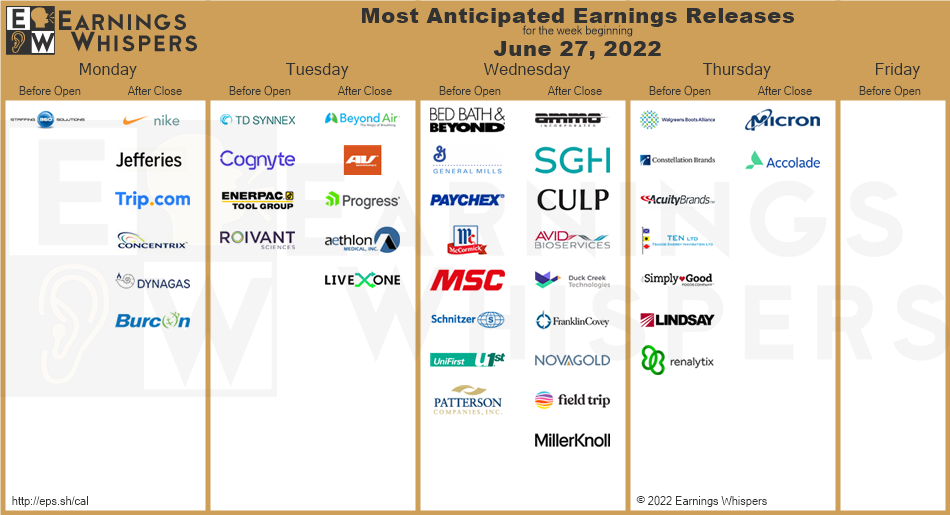
Week of June 17, 2022 Weekly Recap & The Week Ahead

Tuesday, June 21st, 2022

“We simply attempt to be fearful when others are greedy and to be greedy only when others are fearful.” — Warren Buffett

1. Fed Hikes 75 Basis Points, Powell Says 75 or 50 Likely in July — the Federal Reserve raised interest rates by 75 basis points — the biggest increase since 1994 — and Chair Jerome Powell signaled another big move next month, intensifying a fight to contain rampant inflation. He said another 75 basis-point hike, or a 50 basis-point move, was likely at the next meeting of policy makers. They forecast interest rates would rise even further this year, to 3.4% by December and 3.8% by the end of 2023.
2. Bitcoin Price Falls Toward $20,000 as Cryptocurrency Rout Deepens — Cryptocurrencies extended their slide, with bitcoin on the verge of falling below $20,000 for the first time since December 2020. The rout in cryptocurrencies has wiped out roughly 1½ years of gains for bitcoin, which started to soar at the end of 2020 as speculative fervor washed over financial markets. Two high-profile incidents in recent weeks have accelerated cryptocurrencies’ fall. In May, the collapse of stablecoin TerraUSD and its sister token Luna prompted a selloff across cryptocurrencies.
3. Celsius Is Crashing, and Crypto Investors Are Spooked — late last week, Celsius said it was no longer allowing customers to withdraw cash from their accounts. Last Tuesday night, The Wall Street Journal reported that Celsius hired restructuring attorneys to help handle its mounting financial problems. Prices for bitcoin and other cryptocurrencies have been plummeting as interest rates rise and risky assets turn unpopular. The difficult market is forcing once-highflying digital-currency companies to slash jobs, halt mergers and bar clients from withdrawing digital investments, shocking investors. Individual investors might not have realized when they put money in Celsius that they were giving the company an unsecured loan with little legal protection. Crypto companies such as Celsius look like banks in some ways, but they lack the investor oversight and legal protections built into banks and brokerages.

The week ahead — Economic data from Econoday.com:
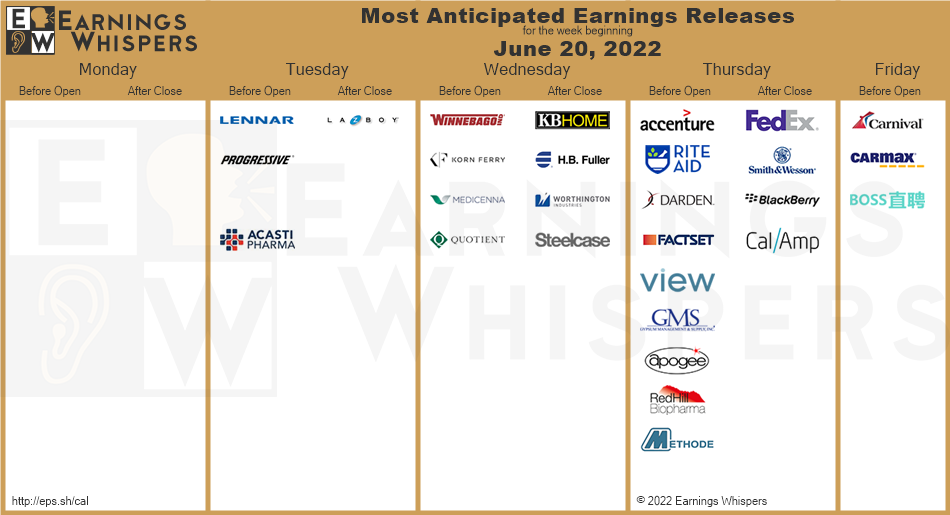
Search
Calendar
February 2026
M T W T F S S
« Jan    
 1
2345678
9101112131415
16171819202122
232425262728  
Archives
Categories
The information provided by The EGS Blog is based on sources believed to be reliable, but it is not guaranteed to be accurate. There is no guarantee that the recommendations of The EGS Blog will be profitable or will not be subject to losses. The information provided by The EGS Blog is not a recommendation or a solicitation that any particular investor should purchase or sell any particular security in any amount, or at all. The investments discussed or recommended herein may be unsuitable for investors depending on their specific investment objectives and financial position. At any time EGS LLC and its principals may maintain positions that are contrary to positions announced within the subscription service. In no event will The EGS Blog be liable to you or anyone else for any incidental, consequential, special, or indirect damage (including but not limited to lost profits or trading losses). PAST PERFORMANCE IS NO GUARANTEE OF FUTURE RESULTS

© Copyright 2026 Market Outlook All Rights Reserved
Design by EGS Sponsored by Equity Guidance LLC