Archive for the ‘Weekly Summary’ Category

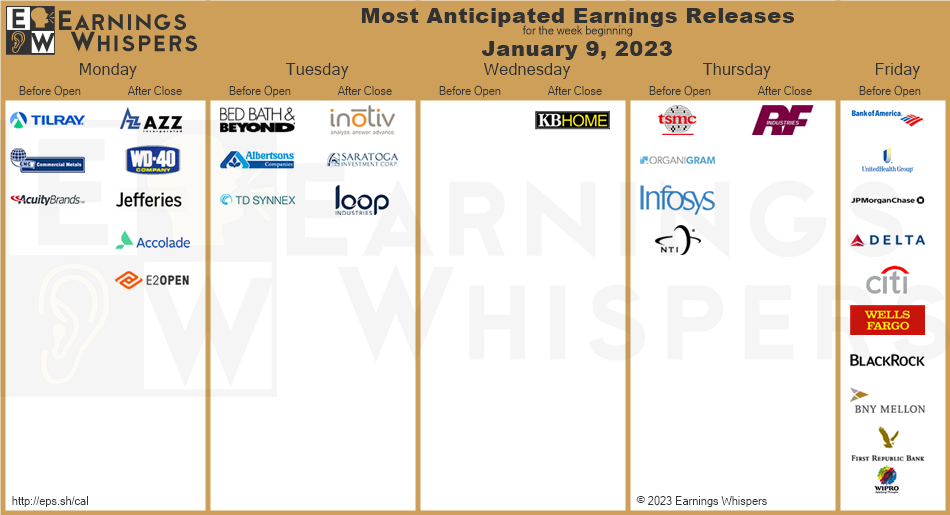
Week of Jan 6, 2023 Weekly Recap & The Week Ahead

Monday, January 9th, 2023

“Be who you are and say what you feel, because those who mind don’t matter and those who matter don’t mind.” — Bernard Baruch

1. Amazon to Lay Off Over 17,000 Workers, More Than First Planned — the Seattle-based company in November said that it was beginning layoffs among its corporate workforce, with cuts concentrated on its devices business, recruiting and retail operations. At the time, the company expected the cuts would total about 10,000 people, but a person with knowledge of the issue said the number could change, The Wall Street Journal reported. Thousands of those cuts began last year.
2. Fed Minutes Show Officials Feared Markets’ Rallies Could Hinder Inflation Fight –minutes of the Fed’s policy meeting last month, highlighted the tricky communications task that has vexed the central bank over the past six months. The Fed’s rapid rate increases last year have fanned investors’ hopes that inflation will slow quickly over the coming year. In the run-up to the December meeting, longer-term bond yields tumbled, reflecting both optimism about a speedy decline in inflation and fears of a recession this year.
But many Fed officials are anxious they won’t be able to defeat inflation unless they can slow the economy by tightening financial conditions, such as by raising borrowing costs or lowering stock prices.
3. Hiring, Wage Gains Eased in December, Pointing to a Cooling Labor Market in 2023 — after two straight years of record-setting payroll growth following the pandemic-related disruptions, the labor market is starting to show signs of stress. That suggests 2023 could bring slower hiring or outright job declines as the overall economy slows or tips into recession.
Employers added 223,000 jobs in December, the smallest gain in two years, the Labor Department said Friday. Average hourly earnings were up 4.6% in December from the previous year, the narrowest increase since mid-2021, and down from a March peak of 5.6%. All told, employers added 4.5 million jobs in 2022, the second-best year of job creation after 2021, when the labor market rebounded from Covid-19 shutdowns and added 6.7 million jobs. Last year’s gains were concentrated in the first seven months of the year. More recent data and a wave of tech and finance-industry layoffs suggest the labor market, while still vibrant, is cooling.
4. New Alzheimer’s Drug Approved by FDA, Promises to Slow Disease — U.S. health regulators gave early approval to a new Alzheimer’s drug from Eisai Co. and Biogen Inc., the most promising to date in a new class of medicines that may help slow cognitive decline caused by the disease.
The Food and Drug Administration granted conditional approval to the drug, called lecanemab, based on an early study finding it reduced levels of a sticky protein called amyloid from the brains of people with early-stage Alzheimer’s. The companies will sell it under the brand name Leqembi.
Eisai said it would sell the drug at a price of $26,500 a year for the average patient, and that it would be available commercially by Jan. 23. A preliminary report by the Institute for Clinical and Economic Review, a nonprofit that works with drugmakers and insurers to evaluate drug prices, said a fair price would be in the range of $8,500 to $20,600 a year.

2022 Market Recap — below is the highlight of events happened in 2022
2022_Recap_1
2022_Recap_2
The week ahead — Economic data from Econoday.com:
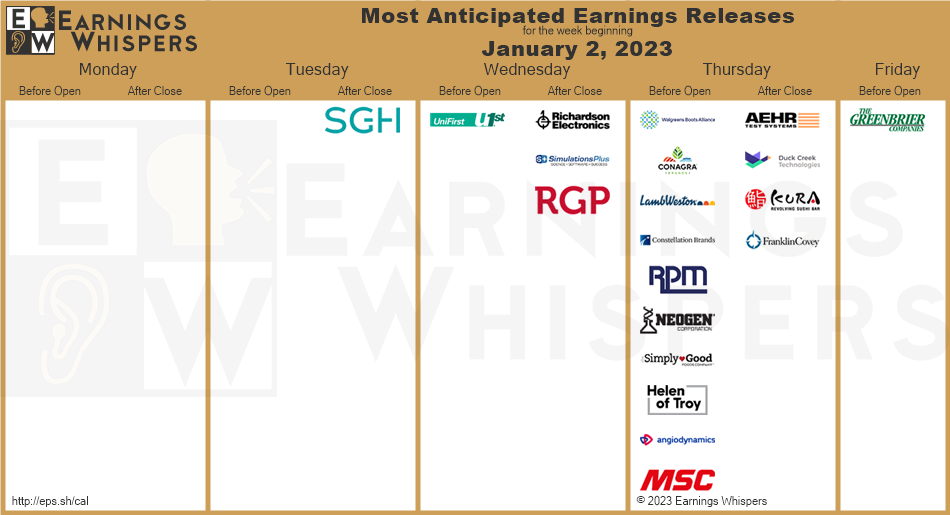
Week of Dec 30, 2022 Weekly Recap & The Week Ahead

Tuesday, January 3rd, 2023

“Happy New Year — wishing our readers a Prosperous, Healthy and Happy New Year — due to a shorten holiday week, no Weekly Recap will be posted”

The staffs at EGS.

The week ahead — Economic data from Econoday.com:
Week of Dec 23, 2022 Weekly Recap & The Week Ahead

Tuesday, December 27th, 2022

Happy Holidays — below is the quote from 2017 Berkshire Hathaway shareholder letter about market volatility:

“If you can keep your head when all about you are losing theirs …
If you can wait and not be tired by waiting …
If you can think – and not make thoughts your aim …
If you can trust yourself when all men doubt you …
Yours is the Earth and everything that’s in it.”

1. 3Q GDP Revised to 3.2% rate — the U.S. expanded at an annual 3.2% annual rate in the third quarter, a more robust pace of growth than previously reported, new government figures show. The increase in gross domestic product, the official scorecard for the economy, initially was reported at 2.6% and updated to 2.9% last month. A bigger increase in consumer spending, mostly on services such as travel and recreation, accounted for the stronger GDP print in the third quarter.
2. US Home Sales Dropped by a Record 35% in November — Purchases dropped 35% year-over-year, according to a recent report from Redfin, marking the largest decline since the real estate brokerage started collecting data in 2012. A separate report found sales that of previously owned homes fell for a 10th-straight month in November — the longest string of declines dating back to 1999.
The Federal Reserve’s attempts to tamp down inflation this year have brought the housing market to a screeching halt, with high borrowing costs sidelining potential buyers. It’s a drastic shift from the buying frenzy early in the pandemic that prompted bidding wars and drove home values though the roof.
3. Key Inflation Gauge Cools, US Consumer Spending Misses Forecasts — the personal consumption expenditures price index excluding food and energy, which Fed Chair Jerome Powell has stressed is a more accurate measure of where inflation is heading, rose 0.2% in November from a month earlier, Commerce Department data showed. That matched estimates, but data for the prior month were revised higher. From a year earlier, the gauge was up 4.7%, a step down from a 5% gain in October. The overall PCE price index increased 0.1% and was up 5.5% from a year ago, the lowest since October 2021 but still well above the central bank’s 2% goal. Looking ahead, the central bank is expected to continue raising interest rates into next year — to a higher level than many investors had expected — and remain restrictive for some time. As for the size of any February rate hike, Powell said the decision will be based on incoming data, and others for December to be released throughout next month.

Week of Dec 16, 2022 Weekly Recap & The Week Ahead

Monday, December 19th, 2022

“The worst trades are generally when people freeze and start to pray and hope rather than take some action” — Robert Mnuchin

1. CPI Report Shows U.S. Inflation Eased in November — the Labor Department on Tuesday said that its consumer-price index climbed 7.1% in November from a year ago, down sharply from 7.7% in October—building on a trend of moderating price increases since June’s 9.1% peak. Core CPI, which excludes volatile energy and food prices, rose 6% in November from a year ago, easing from a 6.3% gain in October. September’s 6.6% increase was the biggest jump since August 1982. Prices softened significantly on a month-to-month basis. The CPI increased 0.1% in November from the prior month, compared with 0.4% in October. Core CPI rose 0.2% in November, down from 0.3% in October and 0.6% in August and September. The CPI measures what consumers pay for goods and services.
The Fed has raised its benchmark interest rate this year at the fastest pace since the early 1980s to combat inflation. It is expected to announce on Wednesday a 0.5-percentage-point increase, bringing rates to a range between 4.25% and 4.5%, the highest level since December 2007.
2. Bankman-Fried Is Charged With Fraud — U.S. prosecutors on Tuesday charged FTX founder Sam Bankman-Fried with eight counts of fraud and conspiracy, in what they called a scheme to defraud his crypto exchange’s customers and his hedge fund’s lenders. The indictment, brought by the U.S. attorney’s office for the Southern District of New York, accuses him of misappropriating FTX.com customers’ deposits and using those to pay expenses and debts of Alameda Research, his crypto hedge fund. Mr. Bankman-Fried is charged as well with defrauding the U.S. and violating campaign finance rules for conspiring with others to make illegal political contributions. The SEC alleged in its lawsuit that Mr. Bankman-Fried diverted customer funds from the start of his cryptocurrency exchange to support his hedge fund, Alameda Research, and to make venture investments, real-estate purchases and political donations. The arrest charges are the latest bombshells in a case that has transfixed Wall Street and Washington. FTX, one of the largest crypto exchanges in the world, filed for bankruptcy last month after it ran out of cash and rival Binance walked away from a shotgun merger.
3. Fed Raises Rate by 0.5 Percentage Point, Signals More Increases Likely — the Federal Reserve approved an interest-rate increase of 0.5 percentage point and signaled plans to keep raising rates at its next few meetings to combat high inflation. At a news conference, Fed Chair Jerome Powell suggested the central bank would strongly consider dialing down the size of rate rises to a more traditional quarter-percentage-point increment at its next meeting on Jan. 31-Feb. 1. Given how high the Fed raised rates this year, “it’s now not so important how fast we go,” Mr. Powell said. Most officials penciled in plans to raise the rate to between 5% and 5.5% next year, with the median projection implying a further 0.75 percentage point in rate rises. In September, they anticipated lifting it to around 4.6% by the end of next year.
4. Retail Sales Fall Sharply as Shoppers Feel Inflation’s Pinch — Retail sales fell more than expected in November, suggesting that while inflation has started to cool off consumers are still feeling the burden of higher prices, pointing to an inauspicious start to the holiday season.
Retail sales last month fell 0.6% to $689.4 billion, a starker decline than the 0.2% decrease economists had been expecting, according to new data from the Census Bureau. This was the biggest drop in nearly a year, which bodes poorly for retailers as they gear up for the last leg of the holiday season. Excluding autos, sales were down 0.2%, and excluding both auto and fuel sales fell 0.2%. In October, retail sales rose 1.3%.
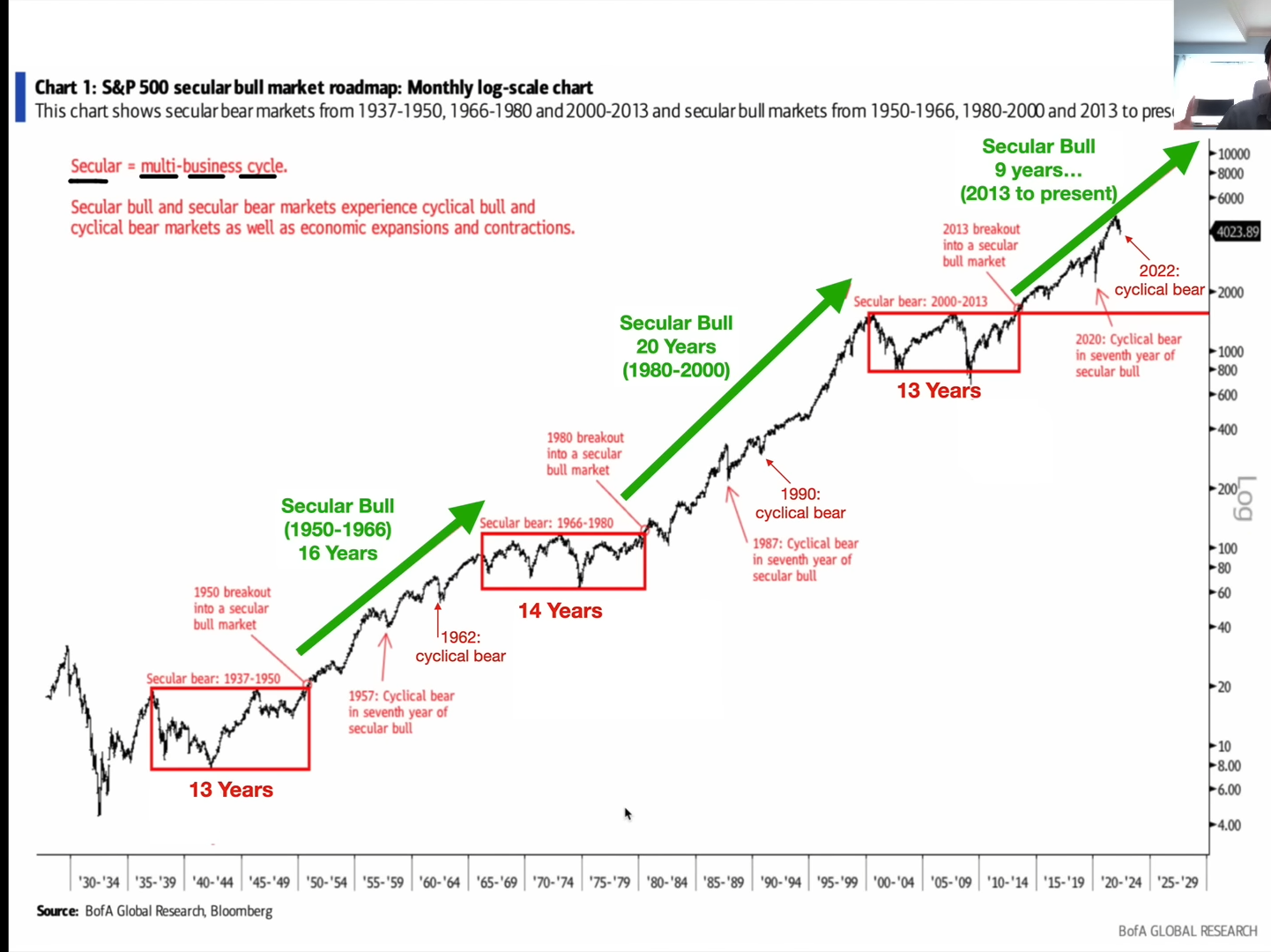
5. S&P 50O Index Secular Bull Market Roadmap Stat from 1929 to Present — table below shows the S&P500 Index returns from 1929 to present courtesy of BofA Research. Note that currently, the S&p500 is in a Bear Market within a Secular Bull.

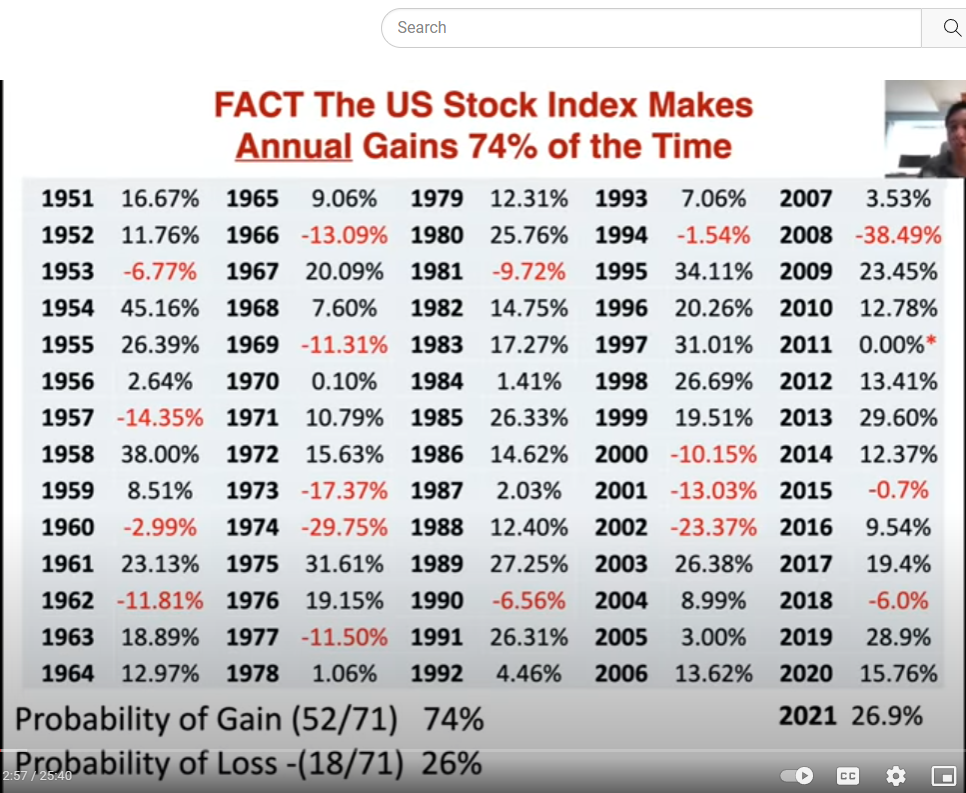
In addition, from 1951 to present, probability of market gain from a down year is approximately 74%. See the figures posted below.

The week ahead — Economic data from Econoday.com:
Week of Dec 9, 2022 Weekly Recap & The Week Ahead

Monday, December 12th, 2022

“I made my money by selling too soon & never lost money by turning a profit” Bernard Baruch

1. Fed to Weigh Higher Interest Rates Next Year While Slowing Rises This Month — Federal Reserve officials have signaled plans to raise their benchmark interest rate by 0.5 percentage point at their meeting next week, but elevated wage pressures could lead them to continue lifting it to higher levels than investors currently expect.
They have raised rates this year at the fastest pace since the early 1980s, including by 0.75 point at each of their past four meetings to combat inflation. Fed Chair Jerome Powell indicated last week that the central bank was prepared to downshift the size of rate increases at its coming meeting on Dec. 13-14. A smaller 0.5-point increase would mark a new phase of policy tightening as they calibrate how much higher to lift rates. Policy makers expect price pressures to ease meaningfully next year, but brisk wage growth or higher inflation in labor-intensive service sectors of the economy could lead more of them to support raising their benchmark rate next year above the 5% currently anticipated by investors.
2. Continuing US Jobless Claims Rise to Highest Since February — recurring applications for US unemployment benefits rose to the highest since early February, suggesting that Americans who are losing their job are having more trouble finding a new one as the labor market shows tentative signs of cooling.
Continuing claims, which include people who have already received unemployment benefits for a week or more, climbed by 62,000 to 1.7 million in the week ended Nov. 26, Labor Department data showed this week.
3. US Producer Prices Top Estimates, Supporting Fed Hikes Into 2023— the producer price index, a measure of what companies get for their products in the pipeline, increased 0.3% for the month and 7.4% from a year ago, which was the slowest 12-month pace since May 2021. Economists surveyed by Dow Jones had been looking for a 0.2% gain.
Excluding food and energy, core PPI was up 0.4%, also against a 0.2% estimate. Core PPI was up 6.2% from a year ago, compared with 6.6% in October. The hot inflation data keeps the Fed on track for another rate increase, likely a 0.5% hike that would push benchmark borrowing rates to a target range of 4.25%-4.5%. Policymakers have been pushing rates higher in an effort to quell stubborn inflation that has emerged over the past 18 months after being mostly dormant for more than a decade.

The week ahead — Economic data from Econoday.com:
Week of Dec 2, 2022 Weekly Recap & The Week Ahead

Monday, December 5th, 2022

“I skate to where the puck is going to be, not where it has been.” … Wayne Gretzky

1. Home Prices Drop for Third Straight Month as US Market Cools — the US housing market pulled back even more in September, with prices slipping 1.2% from a month earlier.
It was the third straight decline for the seasonally adjusted measure of prices in 20 large US cities, according to the S&P CoreLogic Case-Shiller index. The housing market suddenly started to cool this year, driven in part by higher borrowing costs as the Federal Reserve hiked its benchmark rate to tamp down inflation. The more-than-doubling of mortgage rates this year has sidelined potential buyers and slowed demand, leading sellers to list fewer properties.
2. U.S. GDP grew 2.9% in third quarter — Gross domestic product, the official scorecard for the economy, was revised up from a 2.6% rate of growth in the preliminary reading issued last month. GDP had shrunk in the first two quarters of the year. The economy is forecast to expand again in the fourth quarter running from October to December, but estimates vary from as much as 4% to less than 1%. All figures are adjusted for inflation. The main engine of the economy, consumer spending, increased at a solid 1.7% annual clip in the third quarter, the government said. Previously the increase was put at a softer 1.4%.
— Business spending was weak, however. Investment fell sharply in large structures such as office buildings and oil rigs. The housing market also slumped due to soaring interest rates.
— Corporate profits also fell 1.1% in the third quarter. Adjusted pretax earnings declined to an annualized $2.97 trillion.
3. Powell Says the Fed Is Prepared to Slow the Pace of Rate Hikes in December — Fed Chair Powell emphasized that the Fed would be focused on slower but steadier interest rate increases in the coming months, likely reaching a higher terminal, or peak, rate than had previously been expected and keeping rates elevated for some time.
“It makes sense to moderate the pace of our rate increases as we approach the level of restraint that will be sufficient to bring inflation down,” Powell said in a speech at the Brookings Institution. “The time for moderating the pace of rate increases may come as soon as the December meeting.” Powell’s remarks come after the Fed has already raised interest rates by 3.75 percentage points this year over the course of six meetings. In each of the last four meetings, the Fed raised rates by 75 basis points, or three-quarters of a percentage point. The goal for the central bank in slowing its pace is to get a feel for what will be an appropriate level after seeing the impact on the broader economy of this year’s rate hikes, Powell said.
4. US Inflation Indicator Rises by Less Than Forecast as Spending Increases — the personal consumption expenditures price index excluding food and energy, which Fed Chair Jerome Powell stressed this week is a more accurate measure of where inflation is heading, rose a below-forecast 0.2% in October from a month earlier, Commerce Department data showed Thursday. The overall PCE price index increased 0.3% for a third month and was up 6% from a year ago, still well above the central bank’s 2% goal.

The week ahead — Economic data from Econoday.com:
Week of Nov 25, 2022 Weekly Recap & The Week Ahead

Monday, November 28th, 2022

“Throughout my financial career, I have continually witnessed examples of other people that I have known being ruined by a failure to respect risk. If you don’t take a hard look at risk, it will take you.” — Larry Hite

1. Fed Minutes Show Most Officials Favored Slowing Rate Rises Soon — their discussion at the meeting, described in minutes of the gathering released Wednesday, suggests they could downshift to a rate rise of 0.5 percentage point, or 50 basis points at their meeting next month. “A substantial majority of participants judged that a slowing in the pace of increase would soon be appropriate,” the minutes said. Officials approved the fourth consecutive supersize rate increase at their Nov. 1-2 meeting, bringing their benchmark rate to a range between 3.75% and 4%. They are boosting rates at the fastest pace since the early 1980s to reduce inflation that is running near a 40-year high.
All 19 officials at the meeting supported the decision to raise rates this month and broadly agreed they needed to keep lifting them, the minutes showed. Still, the discussion revealed some were more anxious about the possibility of overdoing the increases, while others worried they might not be making enough progress to warrant a downshift.
2. Violent Protests Erupt at Apple’s Main iPhone Plant in China — hundreds of workers at Apple Inc.’s main iPhone-making plant in China clashed with security personnel, as tensions boiled over after almost a month under tough restrictions intended to quash a Covid outbreak. The protest started overnight over unpaid wages and fears of spreading infection, according to the witness, asking to remain anonymous for fear of repercussions. Several workers were injured and anti-riot police arrived on the scene Wednesday to restore order, the person added.
3. China’s Daily Covid Tally Tops 30,000 for First Time as Curbs Spread — China’s daily Covid infections broke through 30,000 for the first time ever as officials struggle to contain outbreaks that have triggered a growing number of restrictions across the country’s most important cities. Rising infections across the country are challenging Chinese authorities who want to shift away from city-wide lockdowns to more targeted measures that are less disruptive to residents and businesses. But after initially easing off on testing and movement restrictions — in line with a new 20-point virus playbook issued by Beijing — officials in some places are again imposing mass testing orders and lockdowns as they strive to meet the overriding objective of suppressing Covid.
That’s meant instead of issuing explicit orders, major cities are locking down apartment block by apartment block and imposing other under-the-radar curbs. In Beijing supermarket delivery apps are being overwhelmed after residents across Chaoyang, its biggest district, were told not to leave their homes unless necessary. Grocery outlets in the district are also no longer taking orders.
4. EU Unveils Proposal to Cap Natural-Gas Prices — the European Union set out the details of a long-debated proposal to cap natural-gas prices on the bloc’s main trading hub, part of an effort to shield consumers from the effects of higher energy costs linked to Russia’s invasion of Ukraine.
The European Commission, the bloc’s executive arm, said that its proposal was designed to deal with exceptional circumstances where the benchmark price for natural gas in Europe exceeds 275 euros, equivalent to about $282, per megawatt hour for two weeks. Prices would also need to be above reference levels by a set margin for 10 consecutive days within those two weeks. The proposal for a price cap, which the commission refers to as a market-correction mechanism, would apply to month-ahead prices on the Title Transfer Facility, a virtual trading hub based in the Netherlands. The commission said over-the-counter trading wouldn’t be affected because it is difficult to monitor and those trades can help in balancing markets.

The week ahead — Economic data from Econoday.com:
Week of Nov 18, 2022 Weekly Recap & The Week Ahead

Monday, November 21st, 2022

“Every battle is won or lost before it’s ever fought” — unknown

1. FTX Says Number of Creditors in Bankruptcy Could Top 1 Million — FTX’s bankruptcy could involve “more than one million creditors,” its lawyers said in court filings late Monday, showing the vast reach the second-largest cryptocurrency exchange had before its downfall. Its sudden collapse this month has jolted the financial world. Digital currencies including bitcoin have fallen significantly in the past week, while lawmakers have stepped up their pushback against crypto-friendly legislative proposals.
2. U.S. Retail Sales Rose 1.3% in October Ahead of Holiday Season — U.S. retail sales rose sharply in October as consumers spent more on everyday staples and big-ticket items such as autos and furniture.
Retail sales—which includes spending on clothing, wine and ottomans but also meals at restaurants—increased a seasonally adjusted 1.3% in October compared with September, when spending was unchanged from the prior month, the Commerce Department reported. Consumers spent more at auto dealers, furniture stores, grocery stores and gasoline stations. Retail sales—which includes spending on clothing, wine and ottomans but also meals at restaurants—have generally risen in recent months amid higher prices and rising interest rates that can make purchases, particularly big ones, more expensive.
3. Crypto Lender BlockFi Plans Bankruptcy Filing Within Days in FTX Fallout — cryptocurrency lender BlockFi Inc. is preparing to file for bankruptcy within days, according to people with knowledge of the matter who asked not to be named because discussions are private. The crypto lender paused client withdrawals, citing uncertainties with FTX, while saying it had adequate liquidity and was exploring options with outside advisers. FTX US and BlockFi are closely tied. In July, FTX US provided the lender with a $400 million revolving credit line, which came with an option to purchase the company. And BlockFi has given loans to now-bankrupt Alameda Research, Bloomberg reported.
The sudden unraveling and subsequent bankruptcy of FTX — once seen as a savior to struggling crypto firms — is reverberating across the digital asset landscape. Bankrupt Voyager Digital Ltd., which Sam Bankman-Fried was going to rescue in a $1.4 billion deal, is now scrambling to find a replacement buyer for its assets. And Genesis is exploring options after suspending redemptions and new loan originations amid a liquidity shortfall.

The week ahead — Economic data from Econoday.com:
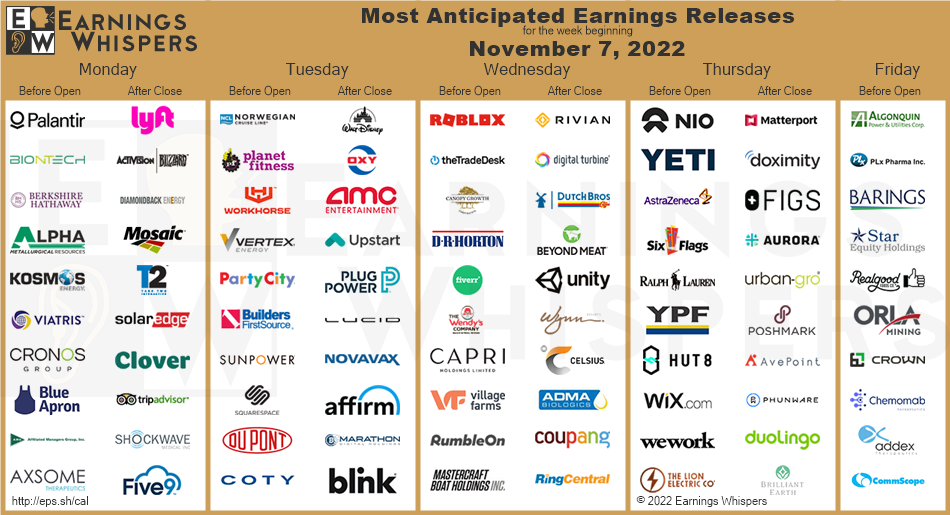
Week of Nov 11, 2022 Weekly Recap & The Week Ahead

Monday, November 14th, 2022

‘Only when the tide goes out that do you discover who’s been swimming naked. ‘ – Warren Buffett.

1. Consumer Prices Rose 7.7% in October From Year Earlier — the Labor Department on Thursday said that its consumer-price index increased 7.7% in October from the same month a year ago, the smallest 12-month increase since January 2022. The reading was down from 8.2% in September. June’s 9.1% inflation rate was the highest in four decades.
On a monthly basis, the CPI rose 0.4% in October from September, the same pace as the previous month. The CPI measures what consumers pay for goods and services.
The so-called core CPI—which excludes volatile energy and food prices—climbed 6.3% in October from a year earlier, down from 6.6% in September, which was the biggest increase since August 1982. The October inflation report could keep Federal Reserve officials on track to approve a half-percentage-point interest-rate increase next month and to pencil in slightly higher rates next year than they had anticipated previously.
2. FTX Hurtles Toward Bankruptcy With $8 Billion Hole, US Probe — the crisis engulfing Sam Bankman-Fried’s FTX.com is rapidly worsening, with the onetime crypto wunderkind warning of bankruptcy if his firm can’t secure funds to cover a shortfall of as much as $8 billion. The acknowledgment of his firm’s deepening troubles and limited options is a stunning turn for Bankman-Fried, who was once worth $26 billion and likened to John Pierpont Morgan. It also underscores the uncertainty hanging over FTX, its clients and cryptocurrency markets.
3. FTX Files for Bankruptcy — beleaguered cryptocurrency platform FTX filed for bankruptcy protection Friday—a swift demise for a company hailed as a trusted platform just a week ago. In a statement, the company said Chief Executive Sam Bankman-Fried resigned from his position but would remain at the company to assist with an orderly transition. FTX said that it would begin a process to review and monetize assets for stakeholders. FTX is the latest in a string of crypto companies seeking bankruptcy protection this year. Months ago, Mr. Bankman-Fried served as a lender of last resort to his industry, following the failure of other crypto companies. Its fortunes reversed in the past 10 days, after a CoinDesk report showed the depth of the relationship between FTX and Alameda, triggering a loss of faith in the platform by amateur and professional investors.
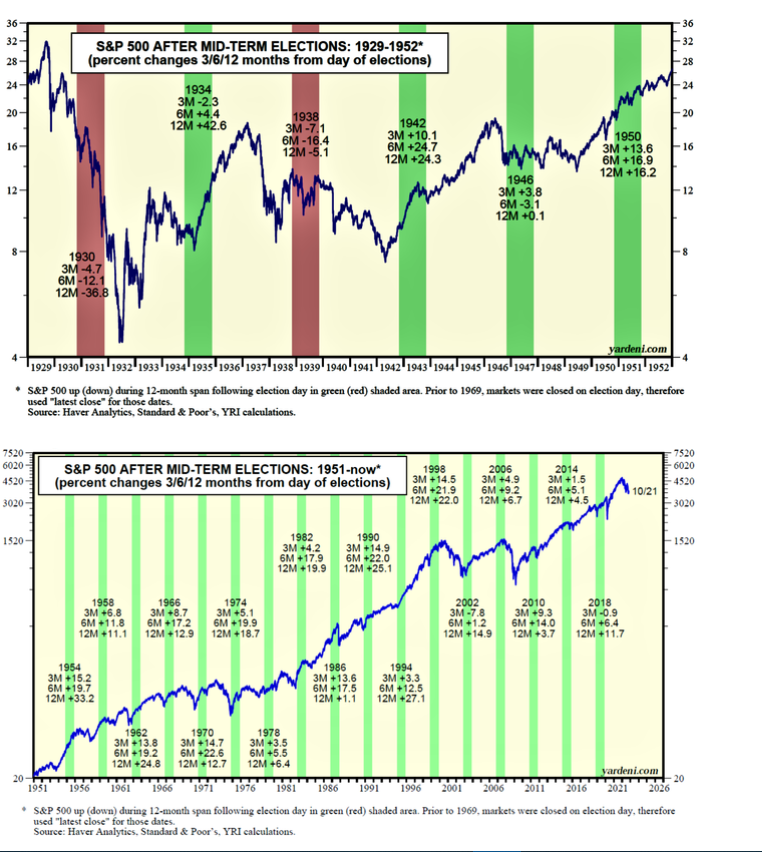
4. The midterm-election effect on the S&P500 Index — historically, midterm elections set up nice rallies with phenomenal consistency. Since 1942, after midterm elections the S&P 500 went up 7.6%, 14.1%, and 14.9% over the next three, six and 12 months, notes Ed Yardeni of Yardeni Research. That’s irrespective of the election outcome. The two charts below show the history. The green- and red-shaded areas represent the 12 months following an election. The percentage market move during the three-, six- and 12-month time frames are written below the election year.

The week ahead — Economic data from Econoday.com:
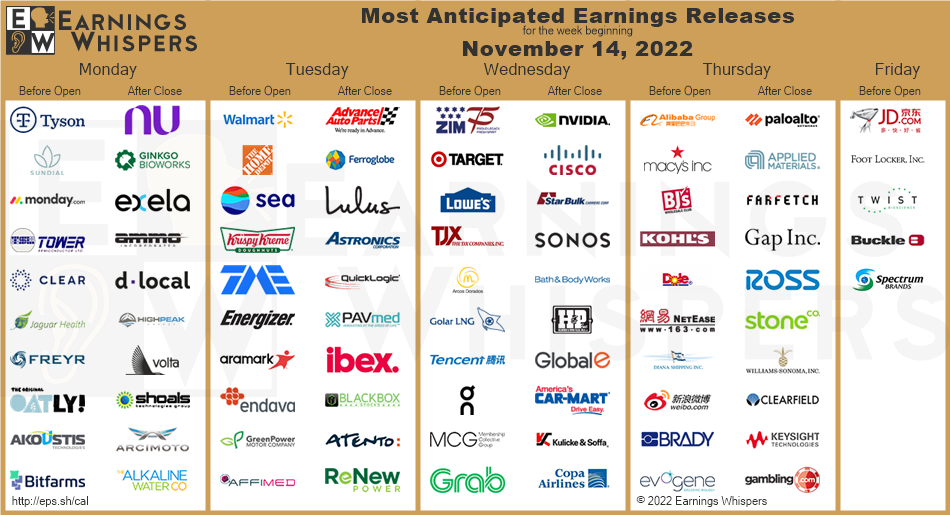
Week of Nov 4, 2022 Weekly Recap & The Week Ahead

Monday, November 7th, 2022

“Markets are never wrong – opinions often are.” — Jesse Livermore

1. Fed Approves Fourth 0.75-Point Rate Rise, Hints at Smaller Hikes — the Federal Reserve lifted interest rates by 0.75 percentage point to combat inflation and signaled plans to keep raising them, though possibly in smaller increments. Fed officials in the latest policy statement acknowledged it could take time for rapid increases this year to be reflected in the economy. “The committee will take into account the cumulative tightening of monetary policy, the lags with which monetary policy affects economic activity and inflation, and economic and financial developments,” they said at the conclusion of a two-day meeting. Officials are boosting interest rates at the fastest pace since the early 1980s to reduce inflation that is running near a 40-year high. They have raised rates by 0.75 point at four consecutive meetings, with the latest one taking the central bank’s benchmark federal-funds rate to a range between 3.75% and 4%.
2. Bank of England Raises Key Interest Rate by 0.75 Point — the Bank of England raised its key interest rate by 0.75 percentage point on Thursday, the largest increase since 1989, in an effort to tame surging inflation but which, by the bank’s own estimates, will help drive the U.K. economy into a recession lasting over a year.
The central bank lifted its benchmark lending rate for the eighth consecutive meeting to 3% from 2.25%, taking it to the highest level since November 2008. Higher borrowing costs will hurt an already weak economy as consumers brace for a difficult winter of falling real incomes and rising prices.
3. Surge in Pediatric Respiratory Viruses, Including RSV, Strains Children’s Hospitals — physicians are reporting unseasonably high numbers of respiratory illnesses in children, straining many children’s hospitals before the typically busier winter months. RSV is an easily transmissible virus that infects the respiratory tract. The virus spreads through droplets from coughing and sneezing and on surfaces. Positive tests for RSV have been on the rise across the U.S., according to the Centers for Disease Control and Prevention. The increase in cases has come ahead of the typical winter peak for such illnesses, hospital officials said. For most people, RSV amounts to a cold, and nearly all children come in contact with the virus by the age of two, health authorities said. But it can be severe for some infants and older adults, especially for those who have pre-existing health conditions.
4. Jobs Report Shows Payrolls Grew 261,000 in October — Employers added a seasonally adjusted 261,000 jobs in October, a robust number but the fewest since December 2020, and the unemployment rate rose to 3.7%, the Labor Department said Friday. Wage gains in October ticked up from the previous month. On an annual basis, however, wage increases have eased, a possible sign of loosening in the labor market. The report points to an economy that is gradually losing momentum following a torrid stretch of growth last year and earlier this year. Over the past three months, employers added an average 289,000 jobs a month, down from 539,000 during the same period a year ago. But that is still far more than before the pandemic. In 2019, job gains averaged 164,000 a month.

The week ahead — Economic data from Econoday.com:
Search
Calendar
February 2026
M T W T F S S
« Jan    
 1
2345678
9101112131415
16171819202122
232425262728  
Archives
Categories
The information provided by The EGS Blog is based on sources believed to be reliable, but it is not guaranteed to be accurate. There is no guarantee that the recommendations of The EGS Blog will be profitable or will not be subject to losses. The information provided by The EGS Blog is not a recommendation or a solicitation that any particular investor should purchase or sell any particular security in any amount, or at all. The investments discussed or recommended herein may be unsuitable for investors depending on their specific investment objectives and financial position. At any time EGS LLC and its principals may maintain positions that are contrary to positions announced within the subscription service. In no event will The EGS Blog be liable to you or anyone else for any incidental, consequential, special, or indirect damage (including but not limited to lost profits or trading losses). PAST PERFORMANCE IS NO GUARANTEE OF FUTURE RESULTS

© Copyright 2026 Market Outlook All Rights Reserved
Design by EGS Sponsored by Equity Guidance LLC