Archive for October, 2025

Week of Oct 24 ’25 Weekly Recap & The Week Ahead

Thursday, October 30th, 2025

“Do not anticipate and move without market confirmation – being a little late in your trade is your insurance that you are right or wrong.” – Jesse Livermore

1. China’s Economy Expands at Slowest Pace in a Year — China said its gross domestic product expanded 4.8% in the third quarter of 2025 compared with a year earlier, down from 5.2% growth in the second quarter. Over the first nine months of the year, China’s economy expanded 5.2% from the year-earlier period, according to the National Bureau of Statistics. That means that Beijing is largely on track to hit its official target of around 5.0% growth for 2025.
Nonetheless, the picture of decelerating growth may prompt Beijing to step up support for the domestic economy as it holds a firm line in its trade fight with the U.S. Tensions between the two superpowers have blown up in recent weeks, the latest twist in a tumultuous year marked by escalating tit-for-tat tariffs and on-again-off-again truces. After Beijing tightened controls over rare earths earlier this month, President Trump threatened an additional 100% across-the-board tariff on Chinese goods.
2. US Government Shutdown Is Now Second Longest in History — The US government shutdown, now in its 22nd day, has become the second-longest in history as the stalemate between the two parties over expiring health-care subsidies persists. With President Donald Trump expected to leave later this week for a trip to Asia, lawmakers and congressional aides say they see a real possibility the closure could extend into November and surpass the 35-day shutdown of Trump’s first term. A meeting at the White House between Trump and Senate Republicans appeared to only strengthen the GOP resolve to refuse to negotiate with Democrats, who have demanded as their price for reopening the government that Congress provide relief to 22 million Americans whose health-care premiums will spike in January.
3. China’s Soybean Feud With Trump Leaves US Farmers With Huge Crops and Few Buyers — Beijing imposed retaliatory tariffs on US farm goods in March, effectively slamming the door shut on US soybean imports for commercial buyers before the harvest even began. The move has given China leverage in its trade war with President Donald Trump by squeezing the farmers who form a key part of his base. A country that last year purchased $13 billion of US beans — more than 20% of the entire crop — for animal feed and cooking oil officially still hasn’t booked a single shipment from this fall’s bounty. Criticizing Trump doesn’t come easily to many farmers. But as soybeans pile up in silos and storage bins, it’s hard not to feel like collateral damage in a fight they didn’t pick. They worry that even if a deal is reached, the war will inflict lasting harm, with China determined to buy more soy from Brazil and Argentina rather than depend on the US. And while they’d accept government financial help during the trade fight, they’d rather be able to sell their beans.
4. US Inflation Data Comes in Soft, Building Case for More Fed Cuts — The core consumer price index, excluding the often volatile food and energy categories, increased 0.2% from August, according to Bureau of Labor Statistics data out Friday. That was the slowest pace in three months and restrained by the smallest increase in a key measure of housing costs since early 2021. In the absence of other official reports during the government shutdown, the highly anticipated reading is a welcome surprise, particularly for several policymakers who are leery of cutting rates further. While the central bank was already widely expected to lower borrowing costs at next week’s meeting, investors are betting the report will help convince officials that they can do so again in December — especially if they don’t get another CPI report next month.

The week ahead — Economic data from Econoday.com:

Week of Oct 17 ’25 Weekly Recap & The Week Ahead

Tuesday, October 21st, 2025

“Markets can remain irrational longer than you can remain solvent.” -John Maynard Keynes

1. Powell Keeps Fed on Track to Lower Rates Again — Federal Reserve Chair Jerome Powell left the central bank on track to reduce interest rates again at its meeting later this month by highlighting weakness in the job market despite lingering concerns over sticky inflation. Separately, Powell hinted the central bank could be approaching the end of a more than three-year campaign to shrink a portfolio of Treasury securities that it acquired to provide stimulus after the 2020 pandemic upended the economy.
2. India Willing to Spend $15 Billion on US Oil Amid Trade Talks — India has the capacity to purchase an additional $15 billion of oil from the US, a senior commerce ministry official said Wednesday, signaling New Delhi’s intent to speed up trade talks and get a deal. The move could bridge the $42.7 billion trade surplus India enjoys and assuage President Donald Trump who has slapped the South Asian nation with a punitive 50% tariff, partly due to its purchase of Russian oil. Indian officials are in the US to meet counterparts and are hoping to secure a deal as early as next month, Bloomberg News reported.
New Delhi’s broad strategy includes reducing the trade surplus by buying more American goods, improving access to Indian markets and easing trade barriers. It is considering roughly $40 billion of big-ticket purchases such as defense and oil from the US to narrow the surplus.
3. Credit-Card Data Show Softer US Retail Sales as Shutdown Delays Report — Economists surveyed by Bloomberg had anticipated the September retail sales report, initially slated for release earlier Thursday but delayed because of the government shutdown, would have shown a smaller advance in the value of purchases after 0.6% increases in the prior two months. After assessing a broad array of high-frequency spending data such as credit-card borrowing and same-store sales, economists say shoppers dialed back purchases after retail activity increased at a robust 4.1% annualized pace in the prior three months. Bloomberg Second Measure, which analyzes credit and debit card data, showed less appetite last month for discretionary items such as furniture, electronics and appliances. Credit-card data from Bank of America, meanwhile, also shows cooler demand.
4. Unemployment Claims Filed by Federal Workers Shoot Higher — Data collected by state unemployment insurance program offices show that last week 7,244 federal workers filed an initial unemployment claim. That was up from 3,272 the previous week, and 588 in the last full week before the current government shutdown, which started Oct. 1. The number of federal workers who had already filed for unemployment, and were continuing to claim benefits, rose to 9,430 from 8,672 the previous week.
The jump in claims likely reflects two forces. The shutdown has prompted many temporarily furloughed workers to file for unemployment. And some of the workers who took the Trump administration’s deferred-resignation plan—and recently lost their paychecks—might be filing for unemployment.

The week ahead — Economic data from Econoday.com:

Week of Oct 11 ’25 Weekly Recap & The Week Ahead

Tuesday, October 14th, 2025

“A good trader watches his capital as carefully as a professional scuba diver watches his air supply.” – Anonymous

1. Fed Minutes Reveal Divide Over Outlook for Interest-Rate Cuts — Officials largely agreed that a recent slowdown in job growth outweighed lingering concerns over sticky inflation when they cut their benchmark rate by a quarter-point last month, to a range between 4% and 4.25%. Most of them thought “it would likely be appropriate to ease policy further over the remainder of the year,” according to minutes of the Sept. 16-17 meeting. But the written account said a few of them thought a rate cut wasn’t necessary last month or could have also supported holding rates steady. The minutes indicated that support for a larger half-point cut was limited to one official, Fed governor Stephen Miran, who dissented from the decision. Miran was appointed by President Trump and sworn in on the morning of the first day of the meeting.
2. Trump Renews Threats With Congress Mired in a Shutdown Brawl — There was no sign of progress as government workers and military personnel prepare for missed paychecks and the general public begins to feel the effects of the closure on everything from taxpayer services to air travel. Trump has repeatedly threatened to fire federal workers, withhold back pay for some government employees and cut funding for programs favored by Democrats, but so far none have materialized. Some Republicans have questioned that strategy, saying it distracts from their messaging to blame Democrats for the shutdown effects. The Senate has canceled plans for a recess next week to stay in Washington if the shutdown persists, a person familiar with the decision said. Speaker Mike Johnson, however, has declined to call House lawmakers back since before the shutdown started, insisting that the House did its job by passing a stopgap funding bill that would reopen the government through Nov. 21.
3. Americans Are Falling Behind on Their Car Payments — Since the pandemic, buyers on auto-dealer lots have encountered surging sticker prices and smaller incentives from automakers to lessen the blow. To afford an automobile, more consumers, especially lower-income families, have resorted to buying used cars and taking out longer loans. The percentage of new-car buyers with credit scores below 650 was nearly 14% in September, roughly one in seven people, J.D. Power said last month. That is the highest for the comparable period since 2016. And the portion of subprime auto loans that are 60 days or more overdue on their payments hit a record of more than 6% this year, according to Fitch Ratings, while delinquency rates for other borrowers have remained relatively steady.
4. China Widens Rare Earth Curbs Ahead of Key Xi-Trump Meeting — China has unveiled broad new curbs on its exports of rare earths and other critical materials, as Beijing moves to shore up its trade war leverage ahead of a high-stakes meeting this month between Donald Trump and Xi Jinping. Overseas exporters of items that use even traces of certain rare earths sourced from China will now need an export license, the Ministry of Commerce said in a statement Thursday, citing national security grounds. Certain equipment and technology for processing rare earths and making magnets will also be subject to controls, according to a separate release.Separately, the ministry later announced plans to expand export controls to a range of new products in measures that will be enforced from November 8. The newly-affected products include five more rare earths — holmium, europium, ytterbium, thulium, erbium — plus certain lithium-ion batteries, graphite anodes and synthetic diamonds, as well as some equipment for making those materials.

The week ahead — Economic data from Econoday.com:

Week of Oct 4 ’25 Weekly Recap & The Week Ahead

Wednesday, October 8th, 2025

The best trading strategy in the world won’t do you any good if you allow emotions to trump logic.

1. Government Shutdown Begins as Funding Lapses — Government funding lapsed early Wednesday morning after the White House and lawmakers failed to reach a spending deal, triggering a shutdown that is expected to halt some federal services and put hundreds of thousands of federal workers on furlough. The shutdown could be more consequential than those that have happened in the past. Trump administration officials have said they plan to use the shutdown to reduce the size of the government, moving to cut jobs across agencies. That effort is already being challenged in court. The funding lapse will have far-reaching ramifications. For the duration of the shutdown, the Labor Department is expected to pause the release of economic data—likely including a highly anticipated jobs report that was set to be made public on Friday. The Centers for Disease Control and Prevention will stop analyzing surveillance data for reportable diseases. Many planned workspace-safety inspections will be canceled. And workers won’t trim grass and install headstones at national cemeteries.
2. U.S. Factory Activity Contracts at Slower Pace — The Institute for Supply Management said Wednesday that its purchasing managers’ index of manufacturing activity edged up to 49.1 in September from 48.7 in August. Economists polled by The Wall Street Journal expected an index of 49.0.
With the reading still below 50, it points to contraction in activity in the sector for a seventh month in a row, though a score above 42.3 on the index generally tallies with expansion in the wider U.S. economy. However, the combined drops in the indexes for new orders and inventories exceeded the increase in the production index, rendering the overall improvement negligible, she said.
3. Trump Eyes Firing ‘Thousands’ of Federal Workers Over Shutdown — President Donald Trump is weighing slashing “thousands” of federal jobs ahead of a meeting with his budget director, Russell Vought, as the White House looks to ratchet up pressure on Democrats to end a government shutdown that has entered its second day. Republicans have sought to use the threat of permanent cuts to the federal bureaucracy to encourage Democrats to vote to reopen the government, and the White House has said firings could happen imminently. But some budget experts have argued that spending money to conduct permanent layoffs during a shutdown is illegal.
4. Trump Explores Bailout of at Least $10 Billion for U.S. Farmers — President Trump is considering providing $10 billion or more in aid to U.S. farmers as the agriculture sector warns of economic fallout from his far-reaching tariffs, according to people familiar with the discussions. The president and his team are weighing using tariff revenue to fund much of the aid, the people said, adding that distribution of the money could start in the coming months. A senior administration official said the discussions have centered on $10 billion to $14 billion in aid. The aid likely would go toward helping soybean producers, as well as other parts of the farm economy. Trump said earlier this week that he planned to push Chinese leader Xi Jinping to buy U.S. soybeans to help struggling American farmers. The two leaders are scheduled to meet on the sidelines of a summit in South Korea in the coming weeks. A deal with China to buy soybeans could change Trump’s calculation about providing aid to farmers, the official said.

The week ahead — Economic data from Econoday.com:

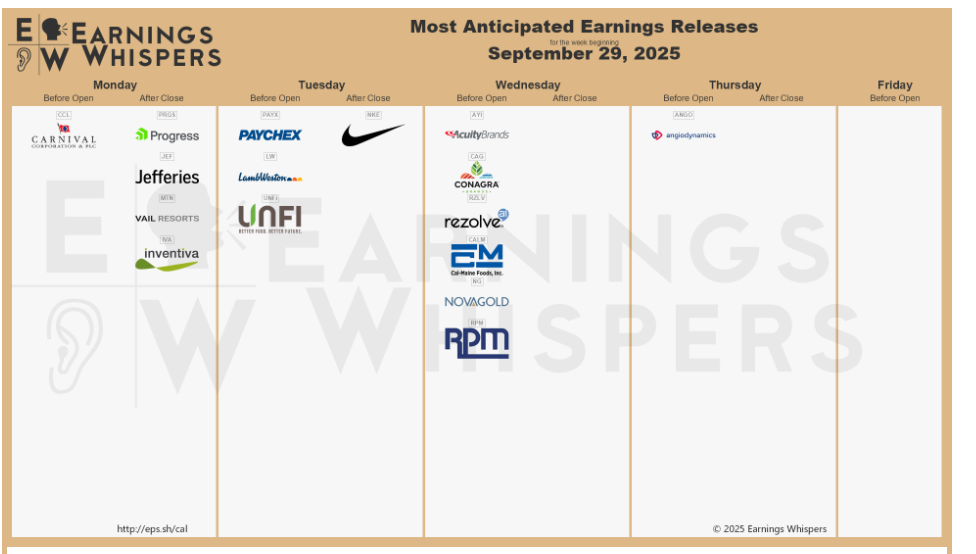
Week of Sept 26 ’25 Weekly Recap & The Week Ahead

Wednesday, October 1st, 2025

“Do More of What Works and Less of What Doesn’t”

1. US New-Home Sales Unexpectedly Jump Over 20% in Broad Advance — New-home sales in the US unexpectedly surged in August to the fastest pace since early 2022, likely lifted by builders’ rampant price cuts and sales incentives. The surge in demand helped put a significant dent in what’s been a vast oversupply of new homes on the market. Last month, the inventory of new homes for sale decreased to 490,000 units, the lowest this year.
2. US Economy Grows at Fastest Pace in Nearly Two Years on Consumer Spending — Inflation-adjusted gross domestic product, which measures the value of goods and services produced in the US, increased at a revised 3.8% annualized pace, a Bureau of Economic Analysis report showed Thursday. That was stronger than the previously reported 3.3% advance and followed an outright contraction in the first quarter.
The BEA also issued its annual update of the national economic accounts, which showed real GDP still increased at an average annual pace of 2.4% from 2019 to 2024. The revisions paint a picture of an economy that quickly rebounded from the initial shock of the pandemic and has since transitioned to period of steadier, trend growth with lingering inflation.
3. PCE Inflation Report: Numbers Come in as Expected, Paving Way for Rate Cut — Consumer spending, adjusted for changes in prices, increased 0.4% last month, according to Bureau of Economic Analysis data out Friday. The consecutive strong gains in consumer spending add to evidence of a solid economy in the current quarter, building upon even greater growth in the prior period than previously thought. However, maintaining such momentum hinges in large part on the labor market, which has shown signs of faltering with slower hiring and more moderate wage gains. Spending on merchandise climbed 0.7%, reflecting discretionary purchases like furnishings, clothing and recreational goods. Outlays for services advanced at a more tempered pace.
4. Daly Says More Rate Cuts Likely But Fed Should Move Cautiously — Policymakers last week lowered interest rates for the first time since December, cutting their benchmark by a quarter percentage point. Daly said she “fully supported” the decision as growth, consumer spending and the labor market have slowed. She added that inflation has accelerated less than she and her colleagues expected, and that price pressures have mainly been confined to parts of the economy directly impacted by tariffs. Before this month’s rate reduction, Fed officials had left rates on hold this year to assess how new policies, including those on trade, would affect the economy.

The week ahead — Economic data from Econoday.com:
Search
Calendar
October 2025
M T W T F S S
« Sep   Nov »
 12345
6789101112
13141516171819
20212223242526
2728293031  
Archives
Categories
The information provided by The EGS Blog is based on sources believed to be reliable, but it is not guaranteed to be accurate. There is no guarantee that the recommendations of The EGS Blog will be profitable or will not be subject to losses. The information provided by The EGS Blog is not a recommendation or a solicitation that any particular investor should purchase or sell any particular security in any amount, or at all. The investments discussed or recommended herein may be unsuitable for investors depending on their specific investment objectives and financial position. At any time EGS LLC and its principals may maintain positions that are contrary to positions announced within the subscription service. In no event will The EGS Blog be liable to you or anyone else for any incidental, consequential, special, or indirect damage (including but not limited to lost profits or trading losses). PAST PERFORMANCE IS NO GUARANTEE OF FUTURE RESULTS

© Copyright 2026 Market Outlook All Rights Reserved
Design by EGS Sponsored by Equity Guidance LLC